
1. Introduction
In recent years, social media platforms have emerged as valuable sources for linguistic analysis (Berdón Prieto et al., 2024; Breeze, 2020; Kumar, 2020; Morin et al., 2024). X, formerly known as Twitter, allows users to quickly exchange short messages. Various frameworks have been applied to examine these brief communications, covering such topics as political discourse (Juares & Ferreira, 2021), health communication (Featherstone et al., 2020), and language ideologies (Kutlu & Kircher, 2021; Vessey, 2015, 2016; Zhao & Liu, 2021), among others.
Recent research trends in social media have run parallel to an interest in the study of regional languages in Spain (Agulló Calatayud, 2011; Beristain, 2021; Casesnoves Ferrer, 2010; Dowling, 2019). This interest is particularly relevant in the case of Valencian, a language with a long literary and institutional tradition. As early as 1395 Antoni Canals referred to the Valencian language in the introduction to Valeri Màxim, and in 1489 Joan Esteve published the Liber Elegantiarum, a manual designed to teach Latin to Valencian speakers. The fifteenth century marked a literary Golden Age in the Kingdom of Valencia, whose capital became a major cultural center of the Crown of Aragon. Over subsequent centuries, dictionaries, grammars, and philological studies consolidated its written tradition, and today Valencian is officially recognized in the Statute of Autonomy of the Valencian Community. Yet the Valencian language remains subject to practices of subordination, which extend into digital arenas where its legitimacy is frequently challenged.
These debates are tied to the long-standing sociopolitical conflict known as La batalla de Valéncia, “The Battle of Valencia” (Mateu & Domínguez, 2011). This sociopolitical conflict revolves around discussions regarding the linguistic status of Valencian and other symbols of identity (Agulló Calatayud, 2011; Casesnoves Ferrer, 2010; Dowling, 2019). Linguistically, the debate has two main perspectives: one views Valencian as an independent Romance language, while the other considers it a dialect of Catalan (Casesnoves Ferrer, 2010). The latter classification is not merely descriptive but ideologically loaded, as labeling a variety a dialect often entails implicit hierarchies and questions of legitimacy.
Within each stance, several positions coexist. Supporters of the first stance range from those who advocate the complete independence of Valencian from Catalan to those who recognize a closer affiliation, viewing Valencian, Catalan, and sometimes Occitan as sister languages. In contrast, among those who consider Valencian a dialect of Catalan, some advocate preservation of its distinctive features, while others diminish its status, labeling it a vulgar or subordinate dialect of Catalan. Indeed, this stance can lead to forms of ideological erasure whereby Valencian’s status as a language is downplayed or dismissed, at times so markedly that the label “Valencian language” is intentionally avoided (Iranzo & Giner-Bosch, 2024).
The existing literature, however, often portrays these groups asymmetrically. The first group, termed here the autochthonist group, is frequently depicted in a predominantly critical light. Some have associated this group with right-wing ideologies, ignorance, intolerance, or violence, often using the term “Blaverism” pejoratively to describe positions that defend the recognition of Valencian as a separate Romance language rather than as a variety of Catalan (Mateu & Domínguez, 2011; Sancho Lluna, 2020). Such framings contribute to a stigmatized representation of the autochthonist group and can shape broader interpretations of its aims and ideological positions. In contrast, the second group, which I refer to as the unionist group, has received comparatively less scholarly attention, particularly with respect to discourses that may delegitimize or dismiss autochthonist claims. This asymmetry in the academic literature risks reproducing ideological biases and may obscure the complexity of the conflict.
This study aims to address this gap by examining the discursive strategies used to challenge the legitimacy of the Valencian language, with particular attention to arguments rooted in linguistic classification, competing glottonyms, and broader processes of ideological delegitimization. To investigate these dynamics, I conduct a thematic analysis of public discourse on X, identifying the strategies mobilized in such critiques and considering how they contribute to broader sociolinguistic narratives about the status and legitimacy of Valencian.
2. Background
2. 1. The Language Subordination Model
This study adopts the definition of language ideologies as “beliefs, or feelings, about languages as used in their social worlds” (Kroskrity, 2004, p. 498). Language ideologies can shape societal perceptions and valuations of linguistic varieties, often dictating which are elevated or marginalized (Flores & Rosa, 2015). Research into linguistic ideologies has expanded, particularly in examining how certain varieties become subordinated to others, often in favor of a “standard” form (Netz et al., 2018). A central model in this area is Lippi-Green’s (2012) language subordination model, which outlines mechanisms that contribute to the promotion of some linguistic varieties over others. This model identifies eight key components, as summarized in Table 1.
The language subordination model has been used to analyze the ideologies surrounding various languages (Cushing, 2023; Vaicekauskienë, 2020). In the Republic of Lithuania, Vaicekauskienë (2020) applied this model to examine attitudes toward the Lithuanian language after the republic’s restoration. The author argues that many Lithuanians experience a fear of ignorance concerning their own language, viewing this ignorance as a threat to the language’s survival and purity. In this context, educational institutions become sites for reinforcing linguistic subordination ideologies, upholding binary judgments of language as either correct or incorrect, valuable or less valuable (Vaicekauskienë, 2020). Vaicekauskienë (2020) showed that practices such as teacher inspections require adherence to the standard language, thereby reinforcing these ideologies.
In England, Cushing (2023) applied the language subordination model to critique the national curriculum, uncovering various mechanisms of subordination. One notable example is the curriculum’s legal authority, which mandates strict adherence from teachers. Cushing argued that the curriculum enforces a restrictive and prescriptive framework that perpetuates false beliefs about language use. The author pointed out that presenting the standard as an improved or additive version of the linguistic varieties students bring to the classroom frames non-standard varieties as incomplete or inferior. Furthermore, Cushing revealed a “threats are made” component of the framework and pointed out that noncompliance with these policies may result in penalties for teachers.
Ultimately, the language subordination model provides a valuable perspective for understanding the mechanisms that perpetuate linguistic inequality. If we acknowledge that discrimination based on skin color, ethnicity, gender, or age is unacceptable, it follows that the delegitimization of linguistic forms, language varieties, and language identities is equally unjustifiable (Lippi-Green, 2012). However, as this article aims to show, the struggle for linguistic recognition and respect remains ongoing in the case of the Valencian language in Spain, where subordination ideologies influence public attitudes and institutional policies.
2.2. The Valencian Language and the Battle of Valencia
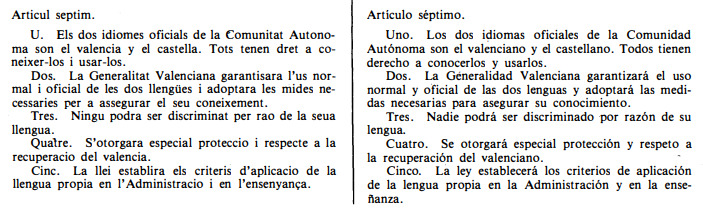
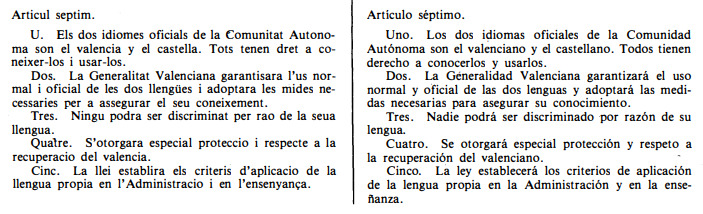
The Statute of Autonomy for the Valencian Community, enacted in 1982, recognizes two official languages: Spanish and Valencian. This statute affirms that both languages have official status and mandates the Valencian government to promote their regular use. Additionally, it prohibits any discrimination based on language. Figure 1 presents an excerpt from the 1982 Statute of Autonomy that refers to the Valencian language.
The sociopolitical conflict surrounding Valencian has long attracted scholarly attention (Lado, 2011; Ninyoles, 1969), particularly in relation to the ideological tensions associated with the “Battle of Valencia” and the competing claims made about the status of the language. Yet this literature has not always reflected the social distribution of these positions with equal clarity. Although data from the Centro de Investigaciones Sociológicas indicate that the autochthonist group is more numerous, this finding is sometimes overlooked, disregarded, or misrepresented in certain accounts. For example, Casesnoves Ferrer (2010) noted:
There is a much more recent political conflict which confronts two different conceptions of the Valencian language: on the one hand, the view held in the context of international linguistics, which considers Valencian as a geographical variety of Catalan, and on the other, the view of a few Valencian speakers [emphasis added] arguing that the Catalan spoken in Valencia is a language different from that spoken in the neighbouring region of Catalonia (henceforth generally called ‘Catalan’). (p. 479)
The claim that only “a few speakers” support the linguistic independence of Valencian is not supported by available evidence. Data from the Centro de Investigaciones Sociológicas (CIS, 2001–2005) show that a considerable share of Valencians perceive Valencian and Catalan as different languages. At the Valencian Community level, 62% in 2001 and 66.8% in 2002 identified them as distinct, while only 29.4% and 25.3% viewed them as the same language, figures that are difficult to reconcile with the idea of a marginal position. The results from the provincial surveys conducted between 2003 and 2005 point in a similar direction, with roughly half or more of respondents in Alacant, Castelló, and Valéncia indicating that the two are different languages, and with proportions surpassing 70% in Alacant in 2004 and 2005. Although Agulló Calatayud (2011) argues that these studies have methodological limitations, the overall trend appears consistent and suggests that perceptions of Valencian as an autonomous language are considerably more widespread than is often implied. In this context, appeals to the authority of “international linguistics” may also risk reproducing forms of erasure (Irvine & Gal, 2000) when they overlook internal diversity within the Valencian Community and oversimplify the sociolinguistic dynamics of the conflict.
Perceptions of linguistic boundaries are not confined to the Valencian Community. Even in Catalonia, views on the unity of the Catalan, Valencian, and Mallorcan language varieties are far from unanimous. Although this may seem surprising, given the distaste for Valencian linguistic identity expressed by certain sectors in Catalonia, the InformeCat (Plataforma per la llengua, 2020) reported that approximately half of the Catalan respondents did not consider Catalan, Valencian, and Mallorcan to be the same language.
While this study uses the labels autochthonist and unionist, as well as the corresponding nouns autochthonism and unionism, the terms Valencianism and Catalanism remain prevalent in both public and academic discourse, where their application is frequently variable and sometimes contradictory. Within the unionist movement, these terms are sometimes regarded as interchangeable. However, from an autochthonist perspective, Valencianism represents a distinctly pro-Valencian movement, one that champions the interests of the Valencian Community and resists what is perceived as an attempt by the unionist group to impose linguistic and cultural subordination. This terminological divergence is reflected in the dictionaries of both Valéncia and Catalonia. For example, the dictionary of the Real Acadèmia de Cultura Valenciana defines valencianism as “A political or cultural movement advocating for the recognition of Valencian nationality and the defense of Valencian interests.” In contrast, the dictionary of the Institut d’Estudis Catalans defines valencianism as “A political movement that advocates for the interests of the Valencian Country” and “Affection for the characteristics and interests of the Valencians.” The Acadèmia Valenciana de la Llengua defines it as “A movement that advocates for the specific interests of the Valencian people, especially their language and culture.” However, the Gran Diccionari de la Llengua Catalana defines valencianism as “Affection for Valencia or the Valencian Country, or for the Catalan national characteristics of the Valencian Country.”
Regarding Catalanism, the Real Acadèmia de Cultura Valenciana defines it as “A political and cultural movement that defends Catalan nationality and the interests of Catalonia.” The Institut d’Estudis Catalans describes it as “A movement that advocates for the recognition of the political personality of Catalonia or the Catalan Countries.” Similarly, the Acadèmia Valenciana de la Llengua defines it as “A movement that advocates for the specific interests of the Catalan people, particularly their language and culture.” Meanwhile, the Gran Diccionari de la Llengua Catalana defines catalanism as “Affection for Catalonia, for the Catalan Countries, or for Catalan national characteristics.” Notably, in these definitions, “Catalan Countries” is intentionally capitalized, which may imply a political dimension. Despite claims that the term “Catalan Countries” has solely a cultural meaning, the capitalization may hint at a political tinge.
As is often the case in conflicts, derogatory terms are used to refer to the opposing side. Unionist discourse sometimes refers to autochthonist positions as blaverisme. This term does not appear in the dictionary of the Real Academia de Cultura Valenciana, although a blaver (a proponent of blaverisme) is defined as a derogatory term for Valencianists. Blaverisme is also absent from the dictionary of the Institut d’Estudis Catalans. However, the Acadèmia Valenciana de la Llengua defines blaverisme as “a social and political movement that advocates for distinctive identity symbols (language, culture, and flag) for the Valencian Community, separate and differentiated from those of Catalonia.” In contrast, the Gran Diccionari de la Llengua Catalana defines blaverisme as “A Valencian regionalism with anti-Catalanist and Spanish nationalist characteristics, which emerged at the end of Francoism and denies the linguistic and cultural unity of the Valencian Country with the Catalan Countries.”
From the autochthonist perspective, unionists are sometimes labeled catalanistas or pancatalanistas, terms that in some discursive contexts function pejoratively. According to the Real Acadèmia de Cultura Valenciana, pancatalanism is defined as a “political movement advocating for the existence of Catalan countries and their political union. It is a neo-imperialist concept rooted in Catalan expansionist nationalism, which seeks to subjugate and annex neighboring territories like Valencia or the Balearic Islands, enforcing linguistic and cultural unification.” The Acadèmia Valenciana de la Llengua defines it as a “political movement that promotes the political union of Catalonia, the Balearic Islands, and the Valencian Community.” It is worth noting that supporting the linguistic unity of Valencian with Catalan does not necessarily equate to being a pancatalanist, as some affirm the linguistic union without any interest in the political union between Valencia and Catalonia. Terminology related to the Valencian language and the conflict surrounding it must therefore be approached with caution, as definitions vary considerably across sources.
In literature that examines this conflict from a unionist perspective, blavers are often portrayed as individuals associated with violence, right-wing ideologies, Catholicism, and ignorance (Mateu & Domínguez, 2011; Sancho Lluna, 2020). For example, Mainar Cabanes (2010, p. 23) considers blavers as la derecha más rancia (“the most rancid right”). Similarly, Mateu and Domínguez (2011, p. 71) describe blaverisme as a “populist, xenophobic, anti-Catalanist, and pro-Spanish movement.” However, Arreaza Aguilera (2021) argues that while some authors classify blaverisme as far right, it is important to note that, despite the presence of violent individuals within the movement, it cannot be entirely categorized as such. Another frequently mentioned point is that those who view Valencian as an independent language from Catalan tend to exhibit negative attitudes toward Valencian itself, particularly regarding its use and status. However, Baldaquí Escandell’s (2005) study suggests otherwise, as he found that a positive attitude toward Valencian can coexist with a negative perception of linguistic unity.
However, although verbal and physical aggression directed toward unionist positions, particularly from sociopolitical movements in Valencia, has been widely documented, dismissive or derogatory discourses targeting autochthonist positions have received remarkably little scholarly attention. To address this gap, this study analyzes a corpus of tweets to examine how users mobilize discursive strategies to challenge the validity of Valencian as a linguistic entity and to disparage its supporters.
2.3. Conducting research on X
Social media has become a valuable and accessible tool for conducting linguistic studies (Anzovino et al., 2018; Berdón Prieto et al., 2024; Breeze, 2020). The real-time interactions make platforms like Twitter (now X) useful for conducting language-related research, and several studies have analyzed hate speech, political discourse, and minority language status on Twitter (Anzovino et al., 2018; Morin et al., 2024; Villazón Valbuena, 2024). For example, Anzovino et al. (2018) examined hate speech on Twitter, focusing specifically on misogyny through the analysis of tweets. In addition to identifying misogynist content, the researchers applied a taxonomy to categorize the different types of misogyny found, such as the discrediting of women, stereotyping and objectification, sexual harassment and threats of violence, dominance, and derailing. Similarly, in the political sphere, Berdón Prieto et al. (2024) conducted a semantic study on Twitter of the Spanish right-wing party Vox. The authors concluded that the party used tweets to denigrate other political groups and ideologies. Furthermore, the researchers argued that this type of messaging from a political party turns opponents into enemies, fostering hate speech and societal polarization. In the British context, Breeze (2020) examined how Nigel Farage uses anger on Twitter to align himself with “ordinary people” against oppressing elites. In this way, Farage creates a sense of identification with his audience, using anger as a means to mobilize support and reinforce populist narratives.
Turning to the study of minority languages in Spain, Villazón Valbuena (2024) examined Twitter discussions about the official status of Asturian. Although the Statute of Autonomy of Asturias does not recognize Asturian as a co-official language, it acknowledges that the language deserves protection and that its use and promotion should be supported. In the study, 158 tweets in different languages (Asturian, Basque, Catalan, English, Galician, Portuguese, Spanish, and Valencian) were analyzed. The study showed how Twitter can become a battleground for defending or opposing the future co-official status of the Asturian language. Barnes (2023) conducted another study on Asturian, focusing on awareness and social meanings linked to certain Asturian linguistic features on Twitter. These tweets included expressions like “speak Asturian,” Asturian linguistic features, such as “ye,” “u,” “es,” “ho,” and “oh,” and lexical items such as “prestar” and “guaje.” Sixty-five tweets were analyzed and coded according to the items previously mentioned. The results showed that “ye” was the most frequently mentioned Asturian feature, followed by “ho” and “/-u/.” Of particular relevance for this study, Barnes (2023) examined a comparable discourse of disrespect directed toward Asturian. A recurrent theme was the delegitimization of Asturian as a language, a phenomenon that is also present in this study. This delegitimizing discourse often works by reducing Asturian to a handful of stereotyped or exaggerated features, as seen in the following tweet (A). Sometimes, the messages are more aggressive, including insults, as in (B).
A. Esos números no se los cree nadie. Un 73% hablando bable???? Si acabar las frases con una “O” y usar “ye” es hablar asturiano, entonces OK, pero el resto, es imposible.
“Nobody believes those numbers. 73% speaking Asturian???? If ending sentences in ‘O’ and using ‘ye’ is speaking Asturian, then OK, but the rest, that’s impossible.”
B. A ver, tonto del culo…hablar Asturiano es acabar todas las palabras en U. Ahí tienes tu mierda de idioma.
“Look, dumbass…speaking Asturian is ending all words in U. That’s your shitty language.”
At the same time, the study identified tweets that attempt to counteract the oversimplification some people make about Asturian, as seen in the following tweet (C):
C. Los locals: hablar asturiano es cambiar todos las -as por -es y -o por -u El asturiano: *tiene tres géneros gramaticales en los que se diferencia masculino -u de neutro -o; y dos formas dialectales de hacer el plural femenino: centroriental -es y occidental -as*
“The locals: speaking Asturian is changing all -as for -es and -o for -u. Asturian: *has three grammatical genders that can differentiate masculine -u from neuter -o; and two dialectal forms of marking the feminine plural: central eastern -es and western -as*”
Finally, Barnes highlights the topic of ridicule directed at the use of Asturian features by non-native speakers, as seen in (D):
D. Cuando alguien que no es de aquí intenta “hablar” asturiano y pluraliza las palabras que terminan en “u” como fatu por ejemplo, fatus.
"When someone who is not from here tries to ‘speak’ Asturian and pluralizes words that end in “u” like fatu, for example, fatus.’
In summary, these linguistic studies show the utility of Twitter as a data source for understanding the ideologies surrounding minority languages. Studies of social media discourse can reveal overt and subtle forms of linguistic discrimination and support the investigation of language ideologies on online platforms. Building on this understanding, the current study examines the specific case of the Valencian language. More specifically, I examine how autochthonist positions are challenged on social media and identify the rhetorical strategies through which the Valencian language, its legitimacy, and its supporters are questioned.
3. The Present Study
3.1. Methods, Sample, and Procedure
In this study, a qualitative thematic analysis was applied to Twitter data following the thematic analysis approach outlined by Braun and Clarke (2006). Thematic analysis is a widely used method for analyzing textual data, including social media content. This framework enables researchers to systematically identify, analyze, and report patterns within data, referred to as “themes” (Braun & Clarke, 2006). Thematic analysis is useful for its ability to capture semantic and latent meanings, thus helping researchers grasp both the overt and the more implicit meanings present in the data (Braun & Clarke, 2021).
The present study followed the phases outlined by Braun and Clarke (2006, p. 87):
-
Familiarize yourself with your data: Transcribe data (if necessary), reading and re-reading the data, noting down initial ideas.
-
Generating initial codes: Coding interesting features of the data in a systematic fashion across the entire dataset, collating data relevant to each code.
-
Searching for themes: Collating codes into potential themes, gathering all data relevant to each potential theme.
-
Reviewing the themes: Checking if the themes work in relation to the coded extracts (Level 1) and the entire dataset (Level 2), generating a thematic “map” of the analysis.
-
Defining and naming the themes: Ongoing analysis to refine the specifics of each theme, and the overall story the analysis tells, generating clear definitions and names for each theme.
-
Producing the report: The final opportunity for analysis. Selection of vivid, compelling extract examples, final analysis of selected extracts, relating back to the analysis to the research question and literature, producing a scholarly report of the analysis.
The thematic analysis of publicly accessible Twitter discourse was conducted as part of this study. Individual tweets served as the unit of analysis (Tadros et al., 2024) and were treated as situated social texts that perform social and ideological work. The analytic process was iterative and recursive: I first familiarized myself with the corpus (reading, translating into English, and noting initial impressions) before generating initial codes that captured ways in which Valencian was discussed. Subsequently, I developed and refined themes that articulated a coherent account of how the status of Valencian was discursively downgraded. My positionality as a Valencian speaker and researcher was explicitly acknowledged as an analytic resource throughout the process. The corpus was considered sufficiently information-rich for the study’s aims, and no attempt was made to achieve data saturation. Tweets were compiled into a secure dataset for analysis.
Informed consent was not required, as the study drew on publicly accessible Twitter content (Moreno et al., 2013; Talbot et al., 2020). Although such material is not subject to formal consent procedures, its use raises important ethical considerations; accordingly, specific tweet dates and usernames are withheld to safeguard user privacy. Additionally, all tweets were translated into English for analytic clarity and to further anonymize contributors.
4. Results
4.1. Themes
The analysis identified seven key themes related to the Valencian language: dialectalization, erasure, mockery and insults, correction, broken Catalan, politics, and false comparisons.
The following sections discuss each theme in turn. The analysis draws on translated tweets, supplemented where relevant by contextual information from prior messages. It is also important to note that a single tweet could sometimes fall under multiple themes.
4.1.1. Dialectalization
The question of whether Valencian is an independent language of the Romance family, or a dialect of Catalan has been a contested issue. In linguistics, it is well understood that the classification of a linguistic variety as a “language” or “dialect” often reflects political decisions as much as linguistic distinctions (Bosque & Gutiérrez-Rexach, 2009; Ciscel, 2006). The designation of a linguistic variety as a “language” is frequently reinforced by an accompanying identity movement that legitimizes and solidifies this status. In the case of Valencian, survey data from the Spanish Centro de Investigaciones Sociológicas indicate that the majority of Valencians perceive Valencian and Catalan as separate languages. This perception is not confined to the Valencian Community; findings from the Informecat2020 study (Plataforma per la llengua, 2020) report similar patterns among respondents in Catalonia. Taken together, these results complicate widely circulated claims that only a small number of Valencians view Valencian as an autonomous language, instead pointing to a considerably broader distribution of this perception across both regions.
Processes of downgrading a linguistic variety’s status to that of a “dialect” are well documented, affecting, for instance, indigenous languages in Mexico and certain regional languages in Spain, including Asturian (Barnes, 2023). This ideological stance is evident in Tweets 1 through 5, where Valencian is framed as a dialect rather than a language.
-
The thing is that we are in Spain. Valencian is a dialect, not a language like Catalan, Basque, or Galician.
-
Valencian is not a language. It is a dialect.
-
Valencian is not a language; it’s considered a dialect of Catalan that has been elevated to the status of a language to distinguish the Valencian Community from Catalonia.
-
Just to clarify: It’s not that Valencian and Catalan are the same language, but that Valencian is not a language but a variety of a language, the Catalan language… got it?
-
The Valencian language does not exist; what exists is Catalan. Valencian is not a separate language; it is a dialect of Catalan.
Tweet 1 establishes a hierarchy, positioning Valencian as less than recognized languages such as Catalan, Basque, and Galician, implying that these languages are more legitimate. Tweets 2 and 5 deny Valencian’s status as an independent language, reinforcing a viewpoint that minimizes its linguistic independence. Tweet 3 suggests that the recognition of Valencian as a language is politically motivated, aimed at differentiating the Valencian Community from Catalonia. Meanwhile, Tweet 4, with a patronizing air, implies that those who view Valencian as a distinct language are misinformed or misunderstand linguistic reality.
4.1.2. Erasure
Erasure, as defined by Irvine and Gal (2000), is a semiotic process that renders certain sociolinguistic phenomena “invisible” (p. 38). This concept is frequently discussed in sociolinguistic studies and is evident in various contexts, such as with the Valencian language in Spain (Iranzo & Giner-Bosch, 2024) or indigenous languages in Nepal (Phyan, 2021). In the present corpus, erasure is evident in tweets that deny the existence of Valencian, thereby attempting to make the language invisible. Tweets 6 to 10 embody an ideology that seeks to erase Valencian by positioning it as nonexistent or irrelevant:
-
The Valencian language does not exist; it was invented just to get financial subsidies.
-
Enough with half-truths and nonsense. The Valencian language doesn’t exist. We need to respect philology. It’s either Catalan or a Valencian variety.
-
You’re speaking Catalan. Valencian does not exist. Do Andalusian and Extremaduran count as distinct languages? Of course not.
-
Valencian doesn’t exist; it’s Catalan that exists.
-
Valencian is not considered a real language.
Tweet 6 associates Valencian with economic and political interests, suggesting that its recognition is a strategy to gain financial subsidies. Tweet 7 appeals to philology as a justification for erasing Valencian’s status, yet reflects a misunderstanding of contemporary philology, which increasingly values linguistic diversity and linguistic identity, as well as the legitimacy of disparate linguistic varieties (Tecedor & Pascual y Cabo, 2020). Tweet 8 diminishes Valencian’s unique status by comparing it to Andalusian or Extremaduran, varieties not widely recognized as separate language and lacking a linguistic identity comparable to that of Valencian. Nevertheless, it is worth noting that there are ongoing efforts to raise awareness of the Extremaduran linguistic variety, including initiatives that advocate for its recognition as a language distinct from Spanish. Tweet 9 flatly denies the existence of Valencian, asserting instead that only Catalan is legitimate. Finally, Tweet 10 denies Valencian’s status as a “real” language, casting it as an illegitimate construct.
4.1.3. Mockery and Insults
Similar to Lippi-Green’s (2012) principle of linguistic subordination—that speaking in a particular way leads to the vilification and marginalization of the speaker—some social media users associate those who support the independent linguistic status of the Valencian language with ignorance, lack of knowledge, or being uninformed. This perception extends beyond denying the language’s legitimacy to stigmatizing those who defend it. Some users employ mocking tones and insults when referring to Valencian, as shown in Tweets 11 to 15, to delegitimize both the language and its advocates:
-
Ignorant Valencians refuse to accept that Valencian is not a language… the language of the Valencian Country is Catalan! Open your minds, ignorant people!
-
Valencian doesn’t exist. It’s Catalan, and anyone who says otherwise is a fucking ignoramus.
-
Even one of your own distinguished citizens, the renowned writer Ferran Torrent, states that calling Catalan ‘Valencian’ is a huge absurdity. Maybe it’s time you educated yourself a bit.
-
Let’s see, idiot, Valencian is not a language, you ignoramus; it’s a dialect of Catalan, it’s like saying Andalusian is a language…
-
Are you a complete idiot, or are you just good at pretending? Valencian doesn’t exist; it’s Catalan, you moron.
Tweet 11 exemplifies this subordination by labeling Valencians as “ignorant people” for defending their language, framing their linguistic identity as a product of ignorance. In Tweet 12, explicit insults underscore contempt for those who view Valencian as a language, suggesting that such beliefs indicate intellectual deficiency. Tweet 13 appeals to authority by invoking Ferran Torrent, a Valencian writer, to shame Valencians with the phrase “Maybe it’s time you educated yourself a bit,” reinforcing a narrative that portrays them as uneducated. Tweet 14 uses derogatory language to belittle the intelligence of Valencian advocates, portraying their advocacy as misguided. Finally, Tweet 15 employs direct insults to undermine both the language and its advocates, associating the defense of Valencian with a lack of intelligence.
This discursive strategy is powerful because it can shape how Valencians relate to their own language. When the defense of Valencian as an independent language is socially framed as a sign of ignorance, speakers may internalize this stigma and become reluctant to assert a Valencian linguistic identity publicly due to the anticipated risk of ridicule or social disapproval in certain circles, reinforcing broader discourses of delegitimation.
4.1.4. Correction
This section presents Tweets 16 to 21, which “correct” the use of the term Valencian, suggesting that Catalan is the appropriate alternative, despite Valencian being the term historically used in Valencia and officially recognized in the Statute of Autonomy. Importantly, the use of the glottonym Valencian does not necessarily signal that a speaker considers it a distinct language from Catalan; many Valencians use the term regardless of their position on linguistic unity. What is less common is the use of the phrase llengua valenciana, “Valencian language,” which may point to its status as an independent linguistic entity (Iranzo & Giner-Bosch, 2024). Tweets showing this pattern include:
-
My native language is Spanish. His would be Valencian (talking about the future language of a newborn).
- Response: “I guess you mean Catalan.”
-
I’m curious to know how many people here on Twitter like it if I write tweets in Valencian.
- Response: “I guess you mean Catalan.”
-
Playing Minecraft in Valencian is like rediscovering Minecraft.
- Response: “I guess you mean Catalan.”
-
The same thing happens to me for speaking Valencian in Spain.
- Response: “You mean Catalan. Valencian does not exist.”
-
I lived in Valencia for a short period and ended up speaking Valencian. I loved how much Valencian was used; I wish Basque were heard here as much as Valencian there.
- Response: “In Valencia, you heard Catalan.”
-
My grandmother’s native language was Valencian.
- Response: “Your grandmother didn’t speak Valencian as her native language; Catalan was her native language. Now you say you speak ‘Valencian,’ and that’s the Spaniards’ victory—dividing our land and culture to control us.”
4.1.5. Broken Catalan
In certain instances, the Valencian language is referred to as “broken” Catalan. This judgment aligns with Lippi-Green’s language subordination model, which explains how misinformation is perpetuated, often suggesting that some language varieties are more “correct” than others. Labeling that marginalizes or stigmatizes Valencian may serve as an attack on both the language and its speakers, and it can also lead users to abandon their language variety and develop forms of linguistic insecurity and self-hatred. Tweets 22 to 26 are examples of this theme:
-
Valencian? You mean poorly spoken Catalan, I guess.
-
Valencian is not a language, damn it; it’s poorly spoken Catalan!!!
-
Valencian isn’t a language; it’s just speaking poorly.
-
Imagine being that much of an idiot, especially speaking Valencian, which is clearly poorly spoken Catalan.
-
Valencian doesn’t exist. Valencian is poorly spoken Catalan with Spanish influences. Someone had to say it.
Lippi-Green (2001) emphasizes how the concept of “standard” or “proper” language is socially constructed, and varieties that diverge from this standard are often viewed as substandard or broken. In this case, labeling Valencian as a flawed version of Catalan creates a hierarchy of linguistic correctness, implying that Catalan is a superior linguistic variety and that anything deviating from it is inherently less valid or grammatically “broken.” Such discourses may also contribute to the linguistic convergence of Valencian toward Catalan: when speakers internalize beliefs that their own variety is deficient, they may feel pressure to align with what is perceived as the socially prestigious form to gain acceptance or avoid stigma. At the same time, these perceptions can facilitate a shift from Valencian to Spanish, a language with strong social prestige and widespread use in everyday life.
4.1.6. Politics
In the collective belief in Spain, certain political leanings are often associated with specific beliefs about the Valencian language. Those who consider Valencian a dialect of Catalan are typically perceived as left-leaning, while those who view it as an independent language are generally linked to the right (Lado, 2011). Although empirical research on this association remains limited, the repeated circulation of these assumptions within specific groups illustrates how political ideologies can shape perceptions of language. As Fontana (1987) observes:
The strength and persistence of clichés is sometimes astonishing. Repeated again and again by new authors in new books, each reiteration adds authority to them and makes it more difficult for anyone to dare to undertake their revision, challenging the opinion of so many undisputed masters of science. (author’s translation)
Another recurring theme is the idea that Valencian was created as a Spanish strategy to divide Valencians and Catalans. A related but equally unfounded belief circulating on social media posits that Valencian was invented by the Partido Popular (PP), Francisco Franco, the fascists, or any group associated with the political right, as shown in Tweets 27 to 36.
-
That whole ‘Valencian’ thing was an invention of the Partido Popular.
-
Calling Catalan ‘Valencian’ is a strategy by Castile.
-
If you keep calling Catalan ‘Valencian,’ you’re the first ones throwing culture and history in the trash. The first part of Castile’s plan is to divide the Catalan language into smaller languages to fragment it, weaken it, and make it disappear.
-
Valencian doesn’t exist; it’s Catalan, no matter how much the far right tries to impose it. This just shows that they have no clue about languages and dialects consolidated by history.
-
Valencian is an invention by the PP to divide and weaken Catalan. Don’t forget that!
-
I say Catalan because ‘Valencian’ is a political invention.
-
Valencian doesn’t exist as a language; at most, it’s a variety of Catalan. The far right only invented it to divide.
-
Calling Catalan ‘Valencian’ is part of the Bourbon plan.
-
I wouldn’t bet on it, but I’d swear that calling what they speak in Valencia ‘Valencian’ didn’t come up until that fateful time when Aznar was in power.
Several tweets, such as 28, 29, and 33, emphasize the belief that the notion of “Valencian” as a distinct language was fabricated to divide Valencia and Catalonia. For instance, Tweet 29 accuses Castile of orchestrating the fragmentation of the Catalan language to weaken it, framing the promotion of Valencian as a distinct entity as part of a broader political strategy.
Other tweets, including 30, 31, and 34, directly attribute the “invention” of Valencian to right-wing political movements or the monarchy. For example, Tweet 31 claims, “Valencian is an invention by the PP to divide and weaken Catalan,” suggesting that right-wing political actors, such as the Partido Popular, have actively sought to undermine Catalan by endorsing Valencian as an independent language.
Notably, Tweet 35 ties the supposed “creation” of the glottonym Valencian to the administration of José María Aznar, a right-wing politician from the PP, who served as Spain’s President from 1996 to 2004. This tweet implies that the designation of Valencian as a language distinct from Catalan emerged during Aznar’s tenure, despite historical evidence showing that the term Valencian has been used for several centuries.
Linking the claim that Valencian is an independent language to right-wing ideologies serves to delegitimize this position among left-leaning audiences. This dynamic is reinforced by discourses that present Valencian–Catalan unity as inherently aligned with progressive politics, thereby casting support for Valencian linguistic autonomy as incompatible with leftist commitments.
4.1.7. False Comparisons
A strategy used to undermine Valencian’s linguistic status involves comparing it to terms such as Mexican or Andalusian, which refer to regional varieties of Spanish spoken in Mexico or Andalusia. This comparison is problematic for several reasons. First, the glottonym Valencian has a long and well-documented historical presence as the name of the language in Valencia, a phenomenon that is not applicable to Mexican or Andalusian. Second, unlike in Andalusia or Mexico, where there is no notable sociolinguistic debate about whether these varieties constitute distinct languages, the status of Valencian is politically and socially contested. From a linguistic standpoint, it is noteworthy that Valencian is repeatedly compared to Andalusian rather than to more appropriate cases such as the relationship between Galician and Portuguese in the Iberian Peninsula, which provide far more meaningful and analytically relevant parallels. Tweets 36 to 42 illustrate how these false comparisons are mobilized to question the legitimacy of Valencian’s linguistic identity.
-
Valencian doesn’t exist; it’s Catalan with a different accent, just like Andalusian, Brazilian, Mexican, etc.
-
There’s no such thing as Valencian; it’s just Catalan. Does someone from Venezuela speak Venezuelan or Spanish?
-
You’re in Argentina; learn Argentine! (responding to a tweet asserting that in Valencia, people should learn Valencian).
-
If Valencian is a language, then Andalusian should be, too.
-
Valencian doesn’t exist. It’s a Catalan–Occitan dialect—specifically, southwestern Catalan. It doesn’t deserve to be called Valencian, just like it doesn’t make sense for Cubans to say they speak Cuban.
-
Valencian doesn’t exist, nor do ‘Peruvian,’ ‘Australian,’ or ‘Canadian.’
-
It would make sense to call it Valencian if people also said they speak Andalusian in Andalusia or Argentine in Argentina… This is just Spanish imperialism!
5. Discussion
This study examined how the legitimacy of the Valencian language and its advocates is challenged through discourse on social media, identifying the rhetorical strategies used to undermine them. It also traced the linguistic ideologies, political indexicalities, and discourses of delegitimation that structured these attacks and shape speakers’ relationships with Valencian as a linguistic identity. The analysis revealed a recurring pattern of language subordination, articulated through mechanisms such as dialectalization, erasure, mockery and insults, language correction, false comparisons, and the portrayal of Valencian as “broken Catalan.” This delegitimation was often linked to political narratives, particularly those associated with right-wing ideologies, and relied on misleading comparisons that similarly contribute to the reduction of Valencian’s status on platforms like X.
Dialectalization appears in tweets such as “Valencian is not a language. It is a dialect.” This tactic disregards a fundamental sociolinguistic principle: the distinction between language and dialect is more about identity and politics than purely linguistic criteria (Anderson, 2012; Bosque & Gutiérrez-Rexach, 2009; Ciscel, 2006). If the criteria commonly used to classify Arabic varieties as dialects of a single language were applied, the different Romance varieties spoken on the Iberian Peninsula could also be viewed as a single language. Moreover, just as Galician and Portuguese are recognized as separate languages despite their close relationship, the case of Valencian raises comparable questions about linguistic identity and classification. This does not mean that everyone must agree that Valencian and Catalan are different languages (just as the reintegrationist movement in Galicia does not view Galician and Portuguese as separate languages). Instead, the debate would benefit from approaches that engage respectfully with the multiple linguistic identities involved.
Tweets like “The Valencian language does not exist; it has been invented just to get financial subsidies” exemplify the theme of erasure, a strategy that seeks to render Valencian invisible by labeling it as “nonexistent” or “not real.” This rhetoric aligns with Irvine and Gal’s (2000) semiotic process of erasure, in which sociolinguistic phenomena are obscured to uphold dominant narratives. The deliberate erasure of the Valencian language is a recurring phenomenon in Spain. For instance, during the 2023 elections, the left-wing party SUMAR initially included versions of its website in both Valencian and Catalan (El Món, 2024). However, the Valencian version was subsequently removed following political pressure. Similar dynamics appear in Valencian-language textbooks used in the Valencian Community (Iranzo & Giner-Bosch, 2024), where the explicit label llengua valenciana “Valencian language” has been replaced with formulations such as “Language and Literature” or “Valencian: Language and Literature,” thereby avoiding direct reference to llengua valenciana.
Mockery and insults, illustrated by tweets such as “Are you a complete idiot, or are you just good at pretending? Valencian doesn’t exist; it’s Catalan, you moron,” subordinate Valencian and its advocates by portraying them as ignorant, backward, or uneducated. This theme includes attacks on Valencian’s linguistic status and personal insults toward its advocates, aligning with Lippi-Green’s framework on the vilification of specific groups. These findings align with Anzovino et al.'s (2018) research on Twitter’s role in facilitating hate speech and discrediting individuals or groups.
The theme of correction is recurring on Twitter, as seen in responses like “I guess you mean Catalan,” which seek to invalidate the glottonym “Valencian” and imply that the term is inappropriate or incorrect, despite its long-standing and historically consistent use. Another delegitimizing tactic categorizes Valencian as “broken Catalan,” with tweets such as “Valencian is not a language, damn it; it’s poorly spoken Catalan!!!.” This portrayal of Valencian as a linguistically deficient variety parallels the stigmatization of Spanish heritage speakers in the United States, who often face criticism of their language variety (Licata, 2023). Within this ideological environment, it is unsurprising that some Valencians may internalize feelings of linguistic inferiority, which can lead them to adopt Catalan lexical items or constructions that are seldom used in their own Valencian varieties.
Politically, framing Valencian as an invention associated with right-wing groups, such as the Partido Popular (PP) or Franco’s regime, complicates its linguistic status. For example, tweets like “If you keep calling Catalan ‘Valencian,’ you’re the first ones throwing culture and history in the trash. The first part of Castile’s plan is to divide the Catalan language into smaller languages to fragment it, weaken it, and make it disappear” illustrate this strategy. This theme suggests that support for Valencian independence is ideologically conservative, reinforcing beliefs that link Valencian–Catalan unity with progressive political commitments and thereby positioning autochthonist views as regressive. For some actors, framing the Valencian–Catalan debate within a familiar left–right dichotomy may be strategically advantageous, although such polarization is not inevitable. In Galicia, for example, defending the status of Galician as a language independent of Portuguese is not necessarily associated with any political ideology.
This study also reveals the use of false comparisons, equating Valencian with language varieties like Andalusian or Mexican Spanish and overlooking their distinct sociopolitical histories and the substantial differences in their institutional, legal, and sociocultural trajectories. Tweets such as “If Valencian is a language, then Andalusian should be too” work to minimize Valencian’s linguistic and cultural identity by implying that the two cases are analogous. These comparisons obscure the fact that Valencian and Andalusian differ along multiple dimensions, including historical development, legal recognition, ideological salience and sociolinguistic function, and thus cannot be meaningfully equated. Such misrepresentations also divert attention from more appropriate points of comparison, such as the relationship between Galician and Portuguese or among the Nordic languages, where issues of linguistic proximity, standardization and differentiation hold greater analytical relevance.
In conclusion, this study showed how social media platforms like X can amplify ideologies that undermine linguistic minority groups. This study’s findings align with the research of Barnes (2023) and Villazón Valbuena (2024), who documented similar instances of delegitimizing discourse on social media concerning the Asturian language. These patterns point to the need for sustained academic attention to the disrespectful and reductive discourses that circulate around minoritized linguistic varieties. In the case of Valencian, a more comprehensive and critically informed engagement with linguistic conflict is essential to avoid partial or ideologically skewed representations and to better understand how such discourses shape public perceptions of linguistic legitimacy.
Two additional points merit consideration in this discussion of Valencian language subordination. First, although such subordinative attitudes are often associated with the unionist discourse, comparable patterns can also be found in other regions of Spain, including those that advocate for the recognition of their own linguistic varieties. For instance, in Asturias, some researchers may support the official recognition of the Asturian language while simultaneously disregarding claims to Valencian linguistic autonomy. This contrast reveals a notable double standard in how linguistic diversity is evaluated across regions in Spain, with linguistic autonomy framed as legitimate or desirable in some territories while comparable claims elsewhere are discounted. These patterns suggest that the recognition of minority languages is often influenced by regional political alignments and broader ideological preferences. This apparent inconsistency, as illustrated by the example of Asturian, may reflect broader political calculations, including concerns that recognizing Valencian as an independent language could be perceived as undermining political alliances or weakening support from Catalan nationalist sectors. Further research is needed to examine the political dynamics that shape these ideological positions and to understand how they circulate across regional contexts in Spain.
Finally, while certain unionists may subordinate and stigmatize Valencian, it would be inaccurate to suggest that all unionists hold these views. As previously discussed, it is similarly overly simplistic to associate all autochthonism with violence, ignorance, or extreme-right ideologies. Within unionist sectors, despite the presence of discourses that undermine or belittle the Valencian language and its advocates, there are also individuals and groups who remain open to dialogue and who actively support the revitalization and preservation of Valencian. This diversity of perspectives reveals the internal heterogeneity of language ideologies and shows that linguistic attitudes are rarely monolithic, but rather shaped by complex sociopolitical and identity-based negotiations.