
It is difficult to talk about an entirely uniform Colombian Spanish intonation when there are so many differences in language use across and within the country. According to Montes Giraldo (2000, p. 55), Colombian Spanish can be classified into different dialectal zones while bearing in mind particular features such as pronunciation, vocabulary, grammar, and intonation. The dialectal regions that Montes Giraldo highlighted were the coastal superdialect and the central or Andean superdialect, which were further divided into other dialectal subzones based on the socioeconomic status of these zones in the country.
In more recent times, many other authors have started to carry out valuable research in these different regions on the intonation of Colombian Spanish vocatives (Huttenlauch et al., 2018), requests (Méndez, 2013), declarative and interrogative statements (Muñetón & Dorta, 2015), neutral and non-neutral declarative statements (Roberto, 2023), and assertive and exclamatory utterances (Velásquez-Upegui, 2015, 2016). Such studies have drawn a clear relationship between pragmatic factors and resulting intonational outcomes; however, all these authors’ objectives have been limited to just five cities (i.e., Bogotá, Bucaramanga, Cali, Cartagena, and Medellín) out of a possible 1,118 distributed across 32 departments in Colombia. Based on this gap, we aim to study the intonation of yes/no (i.e., polar questions; henceforth, PQs) questions of speakers residing on the Caribbean coast of Colombia (departments such as Atlántico, Bolívar, Magdalena, Córdoba, Sucre). Furthermore, previous relevant literature on Colombian Spanish has placed minimal emphasis on sociolinguistic variables, such as age, level of education, sex, and urban versus rural settings, and as such, we begin to address such influences as well.
Literature Review
Spanish ToBI Framework
The creation of the Spanish in the Tones and Break Indices (Sp_ToBI) framework by Beckman et al. (2002) put forth an initial labeling proposal for word- and phrase-level phonological targets couched in the Autosegmental-Metrical (AM) model of intonational phonology. The AM model is a theoretical framework for analyzing and representing intonation in languages. It aims to provide a theoretical account of how intonation works, distinguishing between phonological representations (i.e., tones) and their phonetic realization (i.e., pitch contours) (Pierrehumbert, 1980; Pierrehumbert & Beckman, 1988).
The Sp_ToBI system presented by Beckman et al. (2002) has been modified by researchers such as Face and Prieto (2007), Estebas and Prieto (2008), and Hualde and Prieto (2015). The last of these is currently understood as the most widely implemented approach. The labeling system in Sp_ToBI contains monotonal and bitonal pitch accents (i.e., word-level targets anchored in stressed syllables). The monotonal pitch accents included in Sp_ToBI are H* for high tones and L* for low tones. The association between a stressed syllable and intonational movement through it can be exemplified with the use of an asterisk in the ToBI labeling system. Acoustic evidence of the presence of these tones is observed in the relative upper and lower region of a speaker’s fundamental frequency (F0) range.
The first bitonal pitch accent is L+H*, which is when F0 rises through the stressed syllable, with its peak being achieved at or before the end of the same syllable. Likewise, L+¡H* shows a rise throughout the stressed syllable and a peak occurring at or before the end of the syllable, but the difference between this and the former is that its peak occurs significantly higher than that of the former one (i.e., ¡ denotes upstep). There is also a third rising pitch accent L*+H, which contains a valley throughout the stressed syllable, followed by a clear F0 rise to a peak that occurs post-tonically. Similarly, a rise through the stressed syllable with a peak in a post-tonic syllable is labeled as L+<H*. Finally, the last bitonal commonly included in the pitch accent inventory of Spanish is the falling one, H+L*, which starts with an F0 high near the stressed syllable onset and then falls across the remainder of that syllable.
The main intonational phrase (IP) boundaries, tied to F0 movement in the final syllable of an utterance or completed thought, are the L% and H%.[1] A low boundary tone, L%, is commonly attested in utterances like statements and wh-questions, while H% often concludes PQs, with !H% being its downstepped counterpart (i.e., ascending final movement but not as high of a relative end point). An IP boundary such as HL% happens when an F0 peak occurs first and is followed by a descending excursion to a relative F0 low point. Finally, it is worth mentioning that certain linguistic (e.g., stress pattern, syllable structure) and pragmatic variables (e.g., focus conditions, emotion) have been shown to influence F0 movement trends, and in turn, phonological targets, across varieties of Spanish (see, e.g., Face, 2002; Face & Prieto, 2007; Hualde & Prieto, 2015; Llisterri et al., 1995; Prieto & Roseano, 2010; and Torreira & Prieto, 2007, among others). Of importance to the current work is that, in nuclear (i.e., final) phrase position, which is critical to the expression of pragmatic meaning (Armstrong, 2017; Escandell-Vidal, 1998; Prieto & Roseano, 2010), displaced peaks (i.e., L+<H*) are uncommon due to an upcoming boundary event. Sociolinguistic variables, which are at the core of the current study, will be addressed in an upcoming section.
Colombian Spanish Intonation
Within Colombian Spanish intonation, some researchers have focused on the dialectal differences pointed out by Montes Giraldo (2000), such as Velásquez-Upegui (2014). She investigated the intonation patterns of declaratives, interrogatives, and vocatives in four Colombian Spanish dialects. Her study involved interviews with eight speakers, both male and female, ages 25-50 from Cali, Medellín, Cartagena, and Bogotá. The findings revealed notable regional variation, emphasizing the linguistic diversity across Colombian cities. Specifically, broad focus declarative utterances showed a scarcity of L* tones, while interrogative utterances exhibited differences in nuclear configurations, with the most variation observed in Cartagena.
In a similar vein, Velásquez-Upegui (2015) also worked on the prosodic characteristics of exclamatory sentences compared to assertive ones to determine if they exist as a prosodically independent group or if they constitute assertive statements with variations in pitch in Colombian Spanish. The data came from 16 speakers, two men and two women from each of the same Colombian cities mentioned in her previous study. The results indicated that the differences between the exclamations and the assertions were not only manifested in pitch variation and intensity, but also in the specific prosodic patterns associated with expressive functions.
A prosodic description of commands and requests in the same four Colombian cities is provided in Velásquez-Upegui (2016). Her hypothesis was that pragmatic functions prevail over dialectal variation; that is, speakers would tend to reduce dialectal markers in favor of highlighting specific melodic patterns that allow them to express their communicative intentions. Her findings for this study showed that commands present special features, resulting in a decrease in duration of the nuclear syllable. In contrast, requests exhibited a decrease in tonal range and an increase in the duration of nuclear syllables.
The prosody of declarative and interrogative sentences was also analyzed in Muñoz Builes (2016) and Muñetón (2016). These two studies focused on a female and a male speaker from Medellín using an existing corpus. They examined vowel duration, intensity, and F0, uncovering that the declaratives and interrogatives in question differed in their realization of peaks and the behavior of F0 in prepositional phrases.
Furthermore, Huttenlauch et al. (2018) examined the intonation patterns of vocatives and non-vocatives in Colombian Spanish, focusing on how pragmatic conditions influence prosodic realizations. Their study analyzed semi-spontaneous speech from speakers in Bogotá across three communicative contexts: greeting, confirmation-seeking, and reprimand. The results showed that speaker intention significantly shaped vocative forms, with vocatives exhibiting more nuanced and specific intonation contours than non-vocatives.
Roberto (2023) conducted a recent study on the intonation of Colombian Spanish spoken in Bucaramanga, analyzing spontaneous, semi-spontaneous, and read utterances from four native informants. Her findings revealed that Bucaramanga Spanish shares intonational features with varieties spoken in Cali and Bogotá despite being perceived locally as “arrogant and rude” (Roberto, 2023, p. 32). Neutral declarative statements in her data were marked by a falling pitch accent (H+L*) followed by a low boundary tone (L%). In contrast, non-neutral declaratives featured rising pitch accents with low boundary tones (L+H* L%). For interrogatives, echo questions ended with rising pitch accents and boundary tones (L+H*H%), while disbelief questions concluded with a final fall (L+H*L%).
In a similar line of research, Roberto (2025) analyzed the intonation strategies used by four adult monolingual Spanish speakers from Pasto while presenting old and new information. The Spanish spoken in that city is one of the many Andean varieties of Spanish that are close to Ecuador (Lipski, 1994). In this study, Roberto analyzed broad focus or narrow focus in the subjects and the objects of utterances elicited through a reading task. The reading task was presented through a PowerPoint presentation where participants had to see a picture (AI-generated) with a question, and in the next slide, participants would find the answer they needed to read aloud. In Roberto’s results, she indicated that the most common trend in the subjects was the delayed peak (L+<H*), regardless of focus type, which aligns with previous studies (e.g., Hualde, 2013); however, for verb contours, she failed to observe a pattern since there was a lot of variation regarding both broad focus and narrow focus on the subject. Additionally, she explained that for verbs in sentences with a focus on the object, the most frequent pitch accent was the low-high one (L+H*). Furthermore, the difference in final intonation contours between sentences with narrow focus on the subject and those with focus on the object (H+L* vs. L+H*) highlights the crucial role of sentence-final pitch patterns in marking focus in Spanish.
Polar Question Intonation
Polar questions have been studied in Puerto Rican Spanish (PRS) by Armstrong (2017) and Dominican Spanish (DS) by Willis (2010). These two Spanish varieties share similarities with the varieties of Colombian Spanish spoken in the target region of the current study (i.e., all fall under the “Caribbean” umbrella). Willis (2010) included biased (i.e., echo imperative, confirmation yes-no) questions, which were elicited based on a discourse completion task (DCT). The most frequently used nuclear pitch accent in yes-no questions was H+L*. There was also upstepping that occurred in yes-no questions as well as in wh-questions. He also mentioned that there is a certain intonational similarity in questions produced in DS, PRS, and Canarian Spanish. This similarity is partly due to the fact that, in all three varieties, questions can be realized with a falling nuclear pitch accent.
Armstrong (2017) argued that languages in general express different types of meanings depending on the intonation of PQs. Therefore, she studied the possible meanings of PQs in PRS through production data from 14 speakers, who completed two DCTs. Findings showed that the PRS data in question did not fit perfectly into Escandell-Vidal’s (1998) model for PQs. Armstrong concluded that PQ meanings being conveyed by sentence-final particles in some languages, but through intonation in others, is not typically recognized in the intonation literature yet and that it is important to keep working on this distinction because nuclear configurations are key to distinguishing pragmatic meaning/nuances in questions in general and are the part that typically demonstrate the most contextual variation.
Sociolinguistic Factors and Sound Systems
Linguistic and social factors have been shown to play an important role in intonational variation across Spanish dialects; in particular, speech style, gender, age, socioeconomic status, and urban/rural settings are factors that can help shed more light on such variation. This section is divided into subsections based on social factors that have been studied to date and that have been noted as being relevant to the study of intonation.
Age and Gender
Muñetón and Dorta (2015) incorporated ‘gender’ and ‘urban setting’ into an analysis of Colombian Spanish intonation. They worked on the intonation contours of declaratives and interrogatives of female and male voices of two Colombian speakers belonging to the urban zone of Medellín. This analysis was carried out within the framework of AMPER-Col, and the stimuli analyzed were recorded in the lab at the University of Antioquia. They found that the differences between the two participants’ voices were in maximum peak locations. Features related to initial and final F0 slope, among other aspects found in this study, have phonetic and phonological implications.
A socio-pragmatic analysis of the intonation of Colombian Spanish is presented in Méndez (2013), who framed her study in terms of constructing a social image (i.e., face) involving two terms, autonomy and affiliation, as defined by Bravo (1999). She analyzed how autonomy and affiliation are manifested in the performance and production of the polite and impolite requests of 10 young Colombian women from Bucaramanga, noting that young female speakers tended to show less respect or more camaraderie depending on the situation. Similarly, she mentioned that more than one prosodic pattern was used by speakers to reduce or strengthen the force of an imposition conveyed in impolite or polite requests and to indicate speakers’ needs for affiliation and autonomy.
Similarly, Muñoz Builes (2020) explored the nuclear configurations of assertive statements with broad focus and absolute interrogatives in the Spanish spoken in Apartadó and Medellín, two cities that traditionally belong to two different dialect zones in Colombia (i.e., Coastal and Andean dialect zones according to Montes Giraldo, 1982, 1996, as cited in Muñoz Builes, 2020). Her study analyzed 112 sentences produced by 32 speakers differing in age, sex, and socioeconomic background though the methodology of a DCT. Her findings suggest that both broad focus and absolute interrogatives significantly share the same nuclear contours in both cities. Specifically, the shared nuclear contours include a low monotonal pitch accent and a falling bitonal pitch accent, each marked with a low boundary tone (L*L%, H+(!)L* L%). Regarding the social variables studied, in Apartadó, women ages 20-35 and both socioeconomic strata (high and low) preferred the use of the low monotonal pitch accent (L*), while women ages 36-65 used the falling bitonal pitch accent (H+(!)L*) more often. Men appeared to use both configurations equally. Nevertheless, in Medellín, all social variables favored the use of the low monotonal configuration (L*L%).
Tobin and Enbe (2008) compared and contrasted the intonation of Buenos Aires Spanish (BAS) with that of “classic” (i.e., Castilian) Spanish according to age and gender and how they influence pitch accents and terminal contours. They used a corpus that contained declarative, wh-question, and exclamatory sentences. The results showed that declarative sentences had the most variation based on gender and age. Furthermore, in reference to classic patterns found in wh-question types (e.g., polite, unmarked, emphatic), it was found that most females prefer higher terminal contours in polite wh-questions. Another finding was that all children and adults who participated in the study inserted pitch accents in the stressed syllables of content words (i.e., nouns and verbs).
Speech style and sex were two variables considered by Henriksen (2013) in his study about Manchego Spanish. He sought to analyze the intonational patterns of declarative questions and wh-questions of rural communities in south-central Spain, focusing on eight male and eight female speakers of Manchego Spanish. He revealed that speaker sex played a part in style-shifting, since the number of style-shifts was greater for declarative questions in male participants, but greater for wh-questions in females. He also claimed that Manchego men tended to use an early rise pattern to mark local identity or prestige in the community.
Lastly, Goodale (2024) investigated age- and gender-based variation in Uruguayan Spanish intonation, with particular attention paid to Montevideo and the department of Durazno. His study analyzed broad and narrow focus declaratives in both locations. He had 50 participants and used a DCT as the main task to elicit data. According to his findings, Montevideo Spanish shares similar patterns to those found in BAS, with some prenuclear L+H* in the broad focus declaratives and the tritonal L+H*+L in narrow focus declaratives; however, Durazno Spanish displayed late-peaking prenuclear pitch accents (L+<H*, L*+H), which more closely reflects Castilian Spanish. Goodale stated that female informants in both locations exhibited differences in both types of declaratives, with more variability being displayed in Montevideo Spanish. Finally, older speakers in Montevideo produced similar intonational patterns as those found in BAS.
Rural Settings
A study integrating rural settings was run by Hernández (2014), who covered two rural locations in Mexico. Mentioning Quilis (1993), Hernández claimed that his approach is valuable because it reveals significant aspects related to sociolinguistics, such as geographical origin, social environment, and personal characteristics like gender and age. He mostly focused on explaining the differences across nuclear configurations of both rural settings. Hernández pointed out that a common nuclear configuration in Tlaxcalteca rural Mexican Spanish was L+¡H*L%. This corresponded with a circumflex (i.e., rise-fall) configuration in declarative sentences with an extra-high peak in the stressed syllable. For the rural variety of Pátzcuaro, he found four types of nuclear configurations, all of which corresponded with a range of circumflex configurations in declarative sentences.
Roseano et al. (2019) examined information-seeking PQs in the rural settlement of Ferreries on the island of Menorca. They concluded that changes to intonation in and close to urban settings, such as the area of Ciutadella, had not affected the intonation of Ferreries. They also concluded that rural areas were more resilient in the face of potential spreading of linguistic changes in general, including those linked to intonational features.
Likewise, information-seeking yes/no questions have been investigated in Basque Spanish by Elordieta & Romera (2020). They focused on data coming from two non-urban areas (Lekeitio and Ibarra) and were interested in whether the historical and concurrent presence of vernacular varieties of Basque may lead to more occurrence of final falling contours, as well as correlations between final movement type and social factors. In their results, they did not identify any correlation with degree of contact with Basque nor with attitudes towards Basque, claiming that, in rural areas, the presence of Basque is stronger, and the variety of Spanish used by all speakers has merged regardless of their attitudes. Overall, the falling intonation contour is considered a well-established feature of Basque Spanish in non-urban areas.
Socioeconomic Status
Froemming and Rao (2021) presented an acoustic and sociolinguistic analysis of the tritonal pitch accent found in broad focus declaratives of Cuenca, Ecuador. Their results showed that gender was the most determining factor in the use of the tritonal pitch accent, leading them to suggest that women were playing the role of innovators. They also pointed out that social variables, such as socioeconomic level, were important, claiming that the tritonal denoted a connection to lower socioeconomic groups.
Blas Arroyo (2008), as cited in Froemming & Rao (2021), emphasized the importance of social factors, such as sex, age, and social class, as key variables in linguistic variation across the Spanish-speaking world. These non-structural variables have consistently shown strong correlations with linguistic patterns, both in general sociolinguistic research and specifically within Hispanic linguistics (see Froemming & Rao, 2021; Holguín-Mendoza, 2018; Martín Butragueño, 2004). Among these, education level is frequently used as a proxy for socioeconomic status, as it correlates with linguistic exposure and communicative norms. Education level also reflects access to resources and occupational opportunities. Scholars such as Labov (2006) have demonstrated that educational attainment often correlates with linguistic behavior and serves as a practical and reliable indicator of socioeconomic positioning. Therefore, this study adopts education level as the operational variable for socioeconomic status.
Summary
In this section, we provided an overview of studies that have addressed sociolinguistic factors that play a significant role in intonational variation, such as gender, age, rural or urban settings, and socioeconomic status. There have been various studies concerning age and gender, and just a few about socioeconomic status. Some of those studies show that gender and age influence pitch accents (Goodale, 2024; Méndez, 2013; Muñetón & Dorta, 2015; Muñoz Builes, 2020), contour choices (Tobin & Enbe, 2008), and style-shifting (Henriksen, 2013), often reflecting social identity and pragmatic intent. Rural settings appear more resistant to intonational change, often maintaining distinctive nuclear configurations (Roseano et al., 2019) or regional intonation patterns (Elordieta & Romera, 2020). Socioeconomic factors, as shown in the Cuenca, Ecuador study (Froemming & Rao, 2021), also influence intonation, with innovative pitch accents linked to women and lower socioeconomic groups. In sum, intonation in Spanish is shown to be both socially and regionally variable.
Current Agenda
Based on the review of relevant literature to this point, we address the following issues to better understand the intonation of PQs in Colombian Caribbean Spanish (CCS). First, we explore the final contours (i.e., nuclear configurations) of the utterances produced by three different groups of individuals residing in urban and rural areas. Second, we investigate whether social factors, such as age, gender, education (linked to socioeconomic status), and length of exposure to speech in urban and/or rural areas, affect speakers’ final contours in PQs.
Methodology
Participants
Thirteen female participants (ages 20-63) and eleven male participants (ages 23-76) participated in this study, all of whom have been given pseudonyms. Based on individual experiences and demographic information, the 24 individuals were divided into three groups: A, B, and C. All participants in group A (see Table 1) were born in towns in the Caribbean region of Colombia, but after some years, four of them moved to Barranquilla and two others moved to Cartagena.
Meanwhile, the participants in groups B and C (see Tables 2 & 3) were born, raised, and continue living in their cities or towns.
Similarly, none of these informants reported having been abroad and half of them reported having upper-intermediate proficiency in English.[2] The other half of the participants do not know any language other than a Colombian variety of Spanish.
Instruments
Background Questionnaire
After providing written consent, participants completed a background questionnaire, which was used to populate the information in the tables in this section.
Discourse Completion Task
The DCT consisted of a set of 16 PQs with three different pragmatic functions: offer, invitation, and imperative. All the situations created were adapted linguistically and culturally for CCS from the version in Armstrong (2017). The task is based on everyday situations and normal plans that participants were familiar with. A sample task item is illustrated in 1.
- Sample task item
- Situation: Tienes muchos guineos en tu bolsa de mercar. Ves a una señora que parece tener hambre en la calle y le preguntas si acepta uno. “You have many bananas in your grocery bag. While you are walking on the street, you see an old woman who seems to be hungry. You ask her if she would like a banana from yours”.
- Target PQ: ¿Le regalo un guineo? “Would you like a banana?”
Data Elicitation Procedure
Data were recorded on participants’ mobile phones from their homes in MP3 and MP4 formats, which were later converted to WAV format. Participants were asked to meet with the researchers via Zoom, where the researchers shared their screen so informants could read the Word document containing the written situations in the DCT. The researchers then read each written context aloud, and participants had to record the scripted PQ for each situation with their own phones. Before each recording, the researchers confirmed that the situation was clear and instructed participants to imagine themselves in that hypothetical context while producing the target PQ. After recording each question, participants sent their audio files to a member of the research team via WhatsApp. Each participant produced 16 unique PQs based on what they heard and read. In total, 384 PQs were generated (24 participants x 16 DCT items).
Analysis
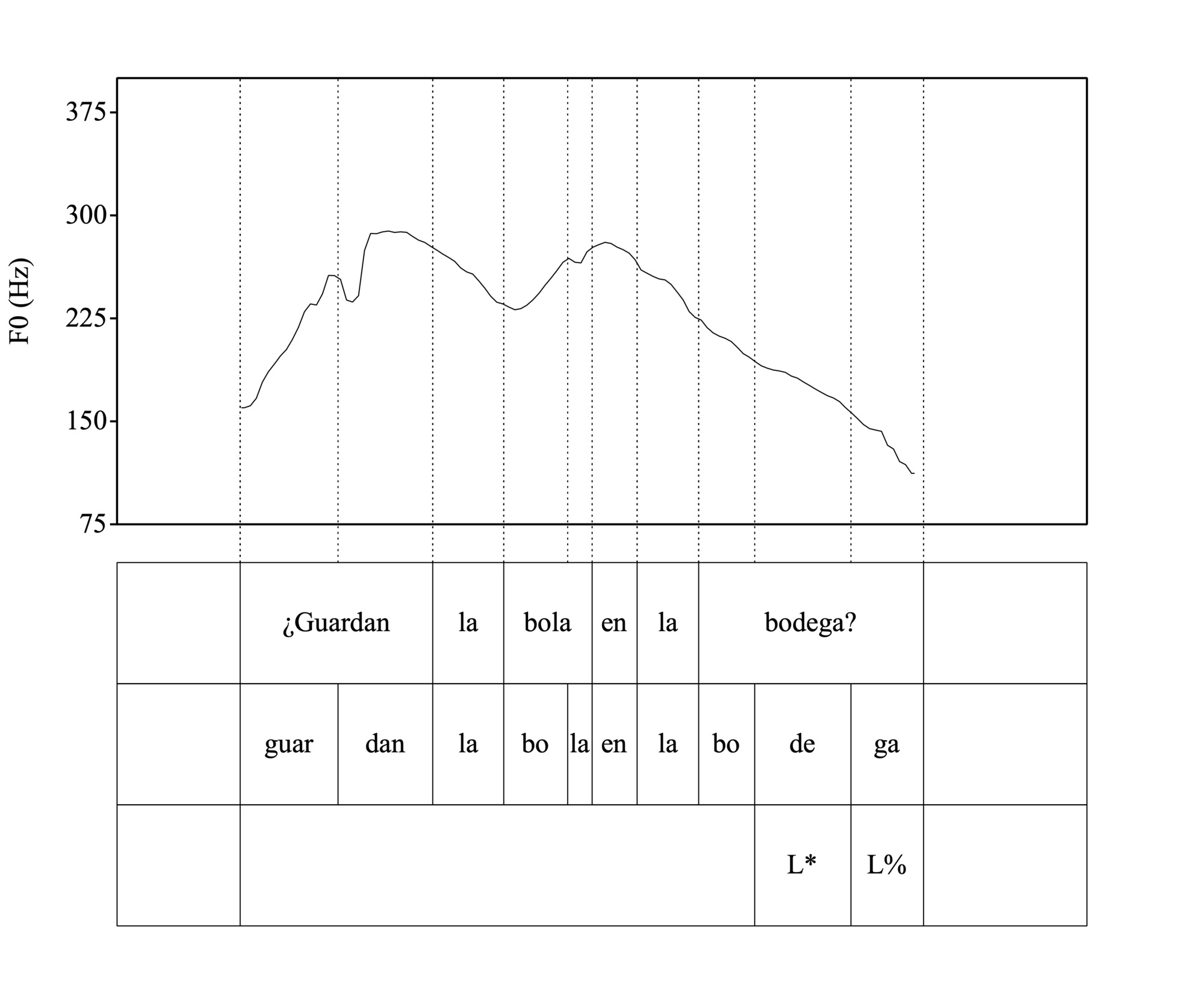
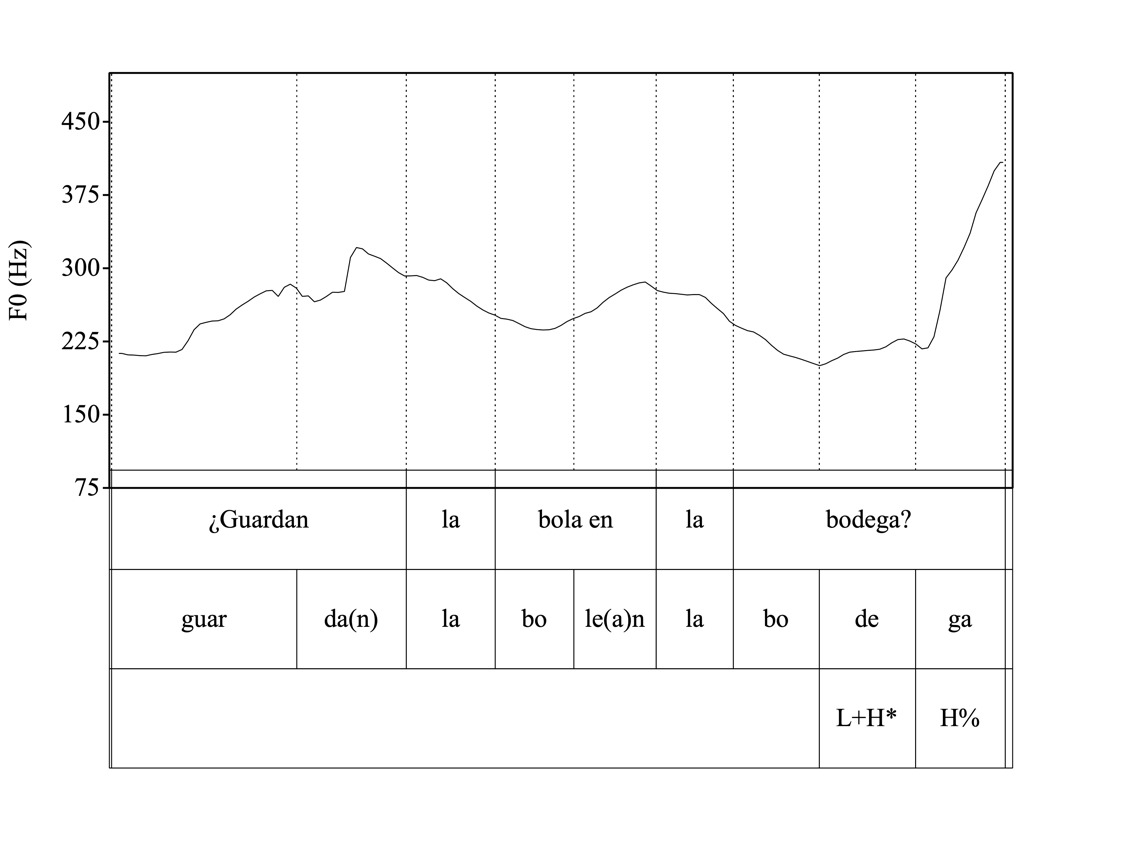
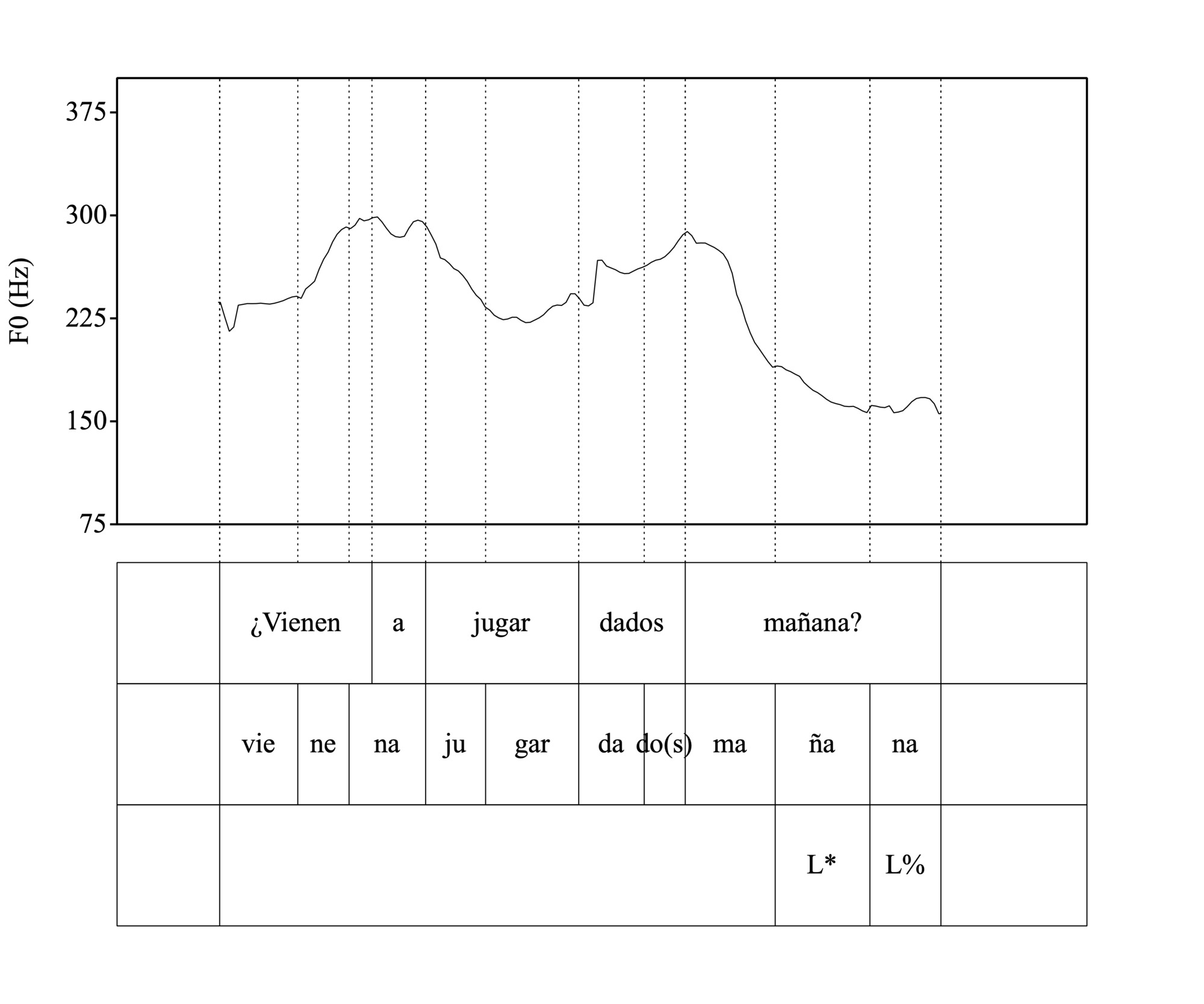
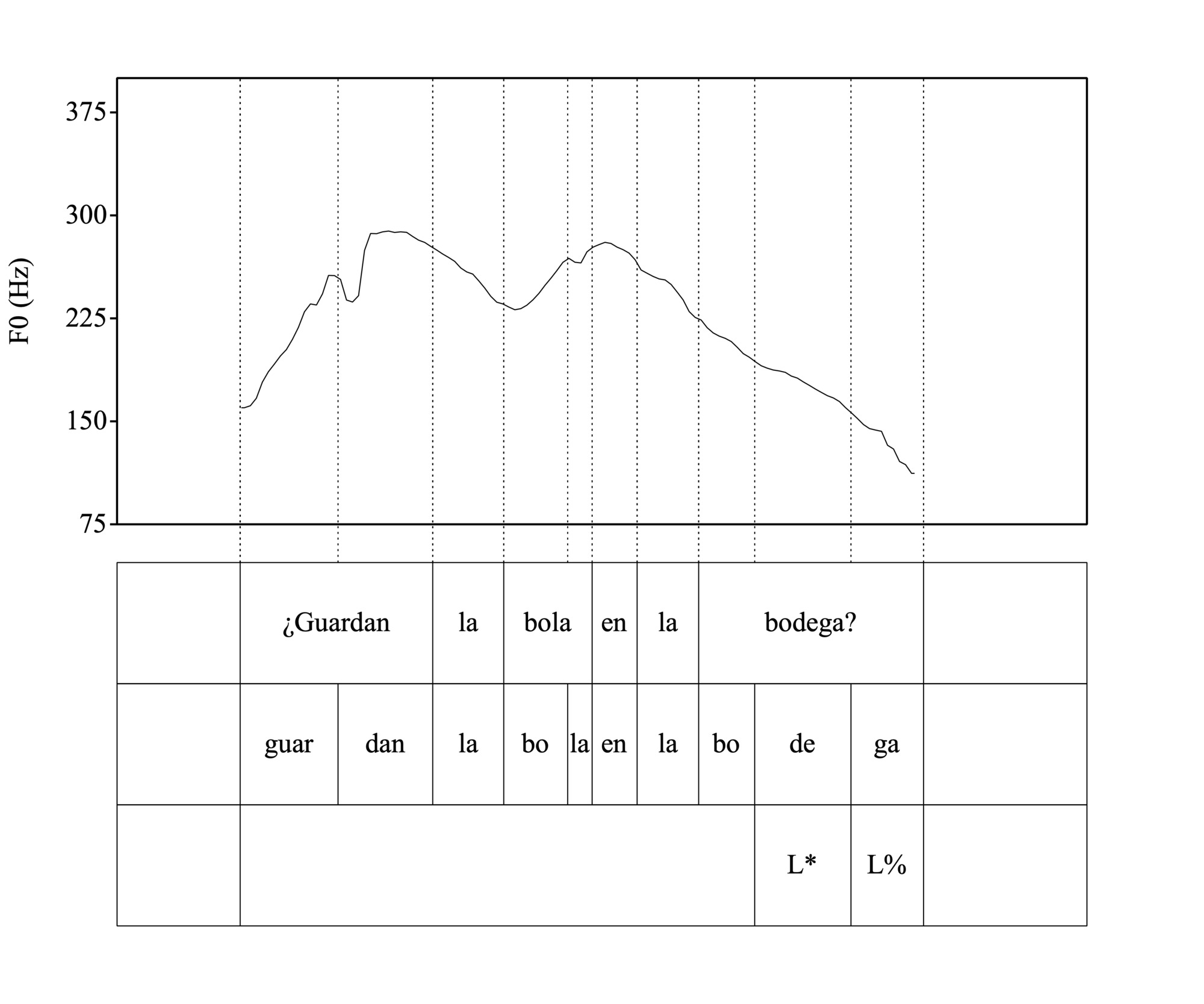
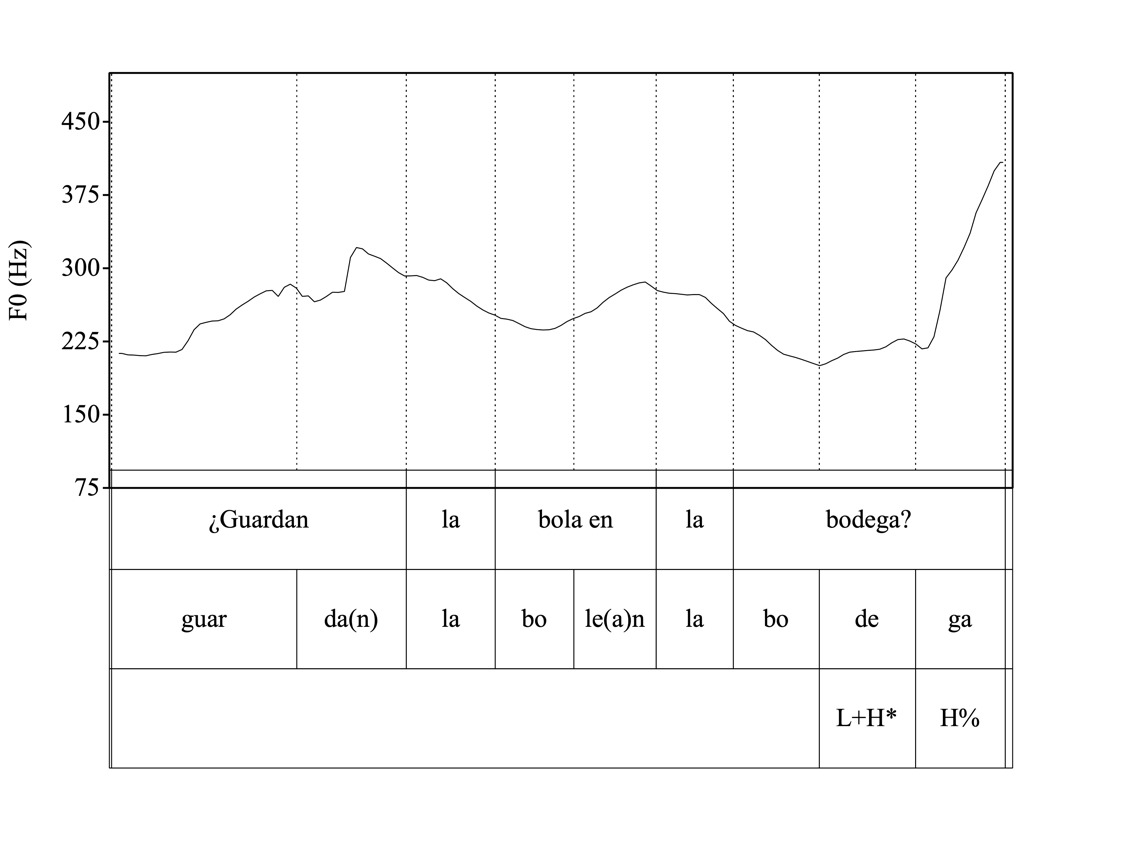
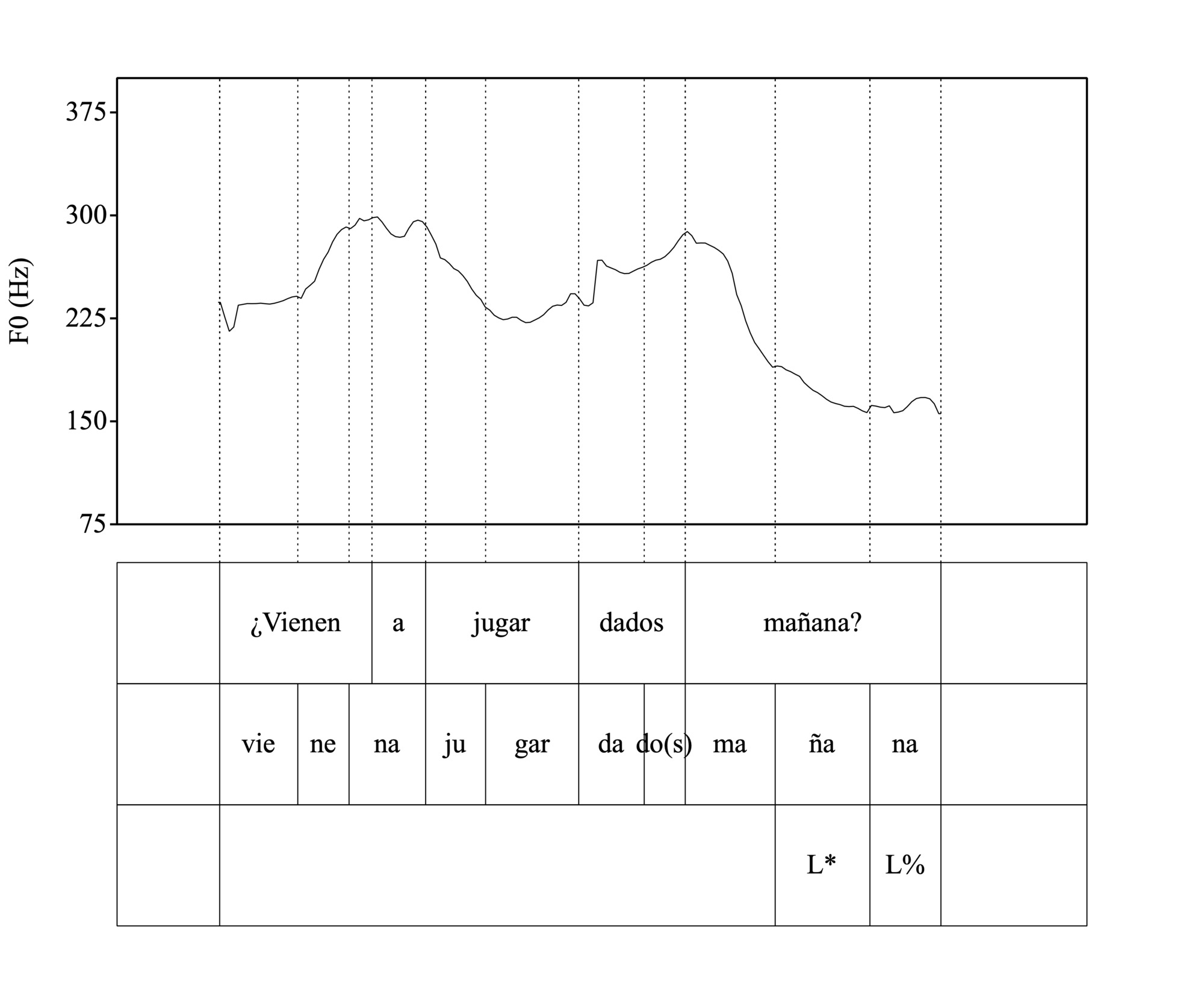
The nuclear configurations of the 384 PQs recorded were analyzed using Praat (Boersma & Weenink, 2011). An inspection of nuclear F0 movement associated with stressed syllables and utterance-final syllables allowed us to appropriately label pitch accents and boundary tones, respectively, using Sp_ToBI conventions. Figures 1, 2 & 3 provide examples taken from the data of the nuclear labeling scheme employed in this paper, the findings for which will be elaborated in the next section.
Results
This section highlights the distribution of pitch accents, boundary tones, and their formation of nuclear configurations based on a series of sociolinguistic variables and our three groups of speaker profiles.[3]
Age
Tables 4 and 5 illustrate pitch accent and boundary tone distributions across our three age groups. Based on these frequencies, we report that all groups tended to use the suppressed L* nuclear pitch accent; however, variation emerged in the choice of boundary tones, with the youngest and oldest participants favoring a rising H% and middle-aged speakers preferring to maintain a low F0 associated with L%. Taken together, we note that age does seem to influence nuclear configurations in PQs, with the sustained low sequence L*L% being most frequent in just the middle-aged group and L*H% being most common in the older and younger group. Interestingly, while L+H* was the secondary preference of pitch accent across all groups, the middle-aged group demonstrated the lowest frequency of this type, thus having the strongest preference for L*. Finally, despite the primary-secondary ranking of boundary tones in each group, it is noteworthy that both H% and L% were produced at considerable rates in all three groups.
The distributional patterns of pitch accents and boundary tones across age groups reveal systematic variation in nuclear configurations within PQs. Although the suppressed L* nuclear pitch accent emerges as the predominant choice across all groups, its pairing with specific boundary tones delineates age-related preferences. Middle-aged participants exhibit a marked preference for L*L%, characterized by a sustained F0 low terminal juncture, whereas both younger and older speakers favor the rising contour L*H%. Notably, L+H* functions as a secondary pitch accent among all age groups. Furthermore, despite intra-group differences in tone selection hierarchies, both H% and L% boundary tones manifest themselves at substantial frequencies across all age groups, suggesting a shared prosodic repertoire and expressive flexibility.
Gender
Table 6 illustrates two predominant nuclear pitch accent trends, with virtually no gender-based difference. First, participants who self-identified as women produced 67.3% of tokens with a relatively flat and descending F0 (L*) and the ones who identified as men generated 68% use of L*. Second, the female group produced ascending F0 movement to a peak within the stressed syllable (L+H*) in 22.55% of cases and men did the same at a frequency of 24.43%.
Noticeably, gender-driven variation was salient in boundary tone implementation. Table 7 shows that the female participants preferred a rising boundary tone (H%) or its downstepped variant. Meanwhile, the male participants favored a falling boundary tone (L%).
In brief, both male and female participants predominantly used the suppressed L* nuclear pitch accent at similar frequencies. The nuclear pitch accent L+H* appeared as a secondary choice across genders. Finally, a key distinction emerged in boundary tone preferences, with women favoring rising tones (H% and its variant) and men exhibiting a preference for a falling tone (L%).
Urban vs. Rural Settings
The frequencies of pitch accents and boundary tones were divided into rural, urban and both settings for all informants, as seen in Tables 8 and 9, where we note that the low pitch accent (L*) is the overwhelmingly preferred one in the rural, urban, and both groups. The second most preferred pitch accent was an early-aligned pitch accent (L+H*) in all three groups, with similar frequencies across the board.
Regarding the realization of boundary tones, L% along with H% were produced at noteworthy rates in all three categories; however, the frequency of H% was the preferred one for participants who live in rural settings as well as those who live in urban areas. Interestingly, the L% vs. H% trend is reversed in the participants from the both group.
In conclusion, pitch accent and boundary tone usage across rural, urban, and both settings show consistent preferences rather than dominate as the primary pitch accent, with L+H* following at comparable rates in all groups. Both L% and H% boundary tones appear frequently, though H% is favored in the rural and urban groups, while participants from the both group demonstrate the opposite trend, favoring L%.
Education (Social Class)
When analyzing participants regarding their education, as shown in Tables 10 and 11, the most frequent nuclear pitch accent was a low one (L*); however, the percentage differs depending on the group, with the low socioeconomic class showing a 52.08% frequency, the middle class a 46.87% frequency, and the upper class a 71.71% frequency. The second configuration most frequently attested was L+H*, appearing at 22.91% for the low socioeconomic status participants, 46.87% for the middle-class ones, and 21.71% for the upper-class ones. We must note that the number of participants and elicitations is not the same for each category, as the upper-class participants comprised a much higher overall portion of the data set.
Finally, although we must continue to consider the disparity in number of generated tokens in the upper vs. lower groups, there is a relatively even split between final falls (L%) and rises (H%) in the upper group, while we see a clearer preference for final falls in the low and mid group.
Overall, we see how speakers across education/socioeconomic classes predominantly favor the low nuclear pitch accent (L*), with the upper-class group exhibiting the highest usage rate. The bitonal L+H* appears consistently as a secondary choice, particularly among middle-class speakers. Despite differences in participant numbers, boundary tone patterns show that upper-class speakers tend to balance terminal rises (H%) and falls (L%), whereas low- and middle-class groups demonstrate a stronger inclination toward final falls (L%).
Results By Group
Now we will draw some conclusions, in the form of descriptive generalizations, linked to individual differences within groups of participants who share a common background.
Group A
Recall that this group consists of six participants (Carlos, Felipe, Ana, Fabio, Alan, and Marcela) who were born in three different towns in the Caribbean region of Colombia and then moved to the urban areas of Barranquilla and Cartagena. Carlos and Felipe produced the same intonation patterns in all types of PQs presented in the DCT; however, it must be noted that they presented a difference in producing offers, where Felipe, who is from Corozal, Sucre, produced a falling nuclear configuration (H+L*L%), and Carlos, who is from Aracataca, Magdalena, maintained the most common contour (L*L%) found across his data. Surprisingly, Anita and Fabio, who are from the same town (El Coley, Sucre), differed in most of their tonal targets (L*H%; L*L%; L+H*H%); that is, they both produced a variety of boundary tones, such as H% and HL%, but Fabio produced essentially the same pattern in all his data L+¡H*HL% or L+H*HL%, while Anita varied her intonation patterns throughout the task, with her most frequent boundary tone being H% with a particularly steep rise.[4] Alan and Marcela, who are from the same town and moved to Cartagena, showed different contour patterns in almost all the situations. As was the case with Carlos and Felipe, Alan produced most of his utterances with a low-fall (L*L%) nuclear contour, whereas Marcela produced most of her PQs with a mid-level rise (indicated by the downstep symbol adjacent to H%) (L*!H%) nuclear configuration.
Overall, the trends here show how gender might be an indicator of different intonational patterns even when both subjects are from similar settings (places); males behave similarly, while females show more variation.
Group B
This group comprised twelve participants (Enrique, Patricia, Yarlin, Sol, Matias, Rosa, Andres, Day, Gerson, Lupe, Catalina, and Maximiliano) who were born and raised in the city of Barranquilla and have lived there their entire lives. Half of the participants in this group (Andres, Day, Gerson, Lupe, Catalina, and Maximiliano) reported being bilingual and the other six informants were monolingual. This monolingual group (Enrique, Matias, Andres, Day, Gerson, and Lupe) favored L*L% nuclear contours, or what seems to be the default intonational pattern among all the participants. Beyond these six, Patricia and Yarlin produced similar boundary tones (H% or LH%) in most PQs, and Sol and Rosa were inclined toward different nuclear contours altogether, as they did not produce any instances of the common L*L%. Sol’s most used nuclear configuration was a low-rising final contour (L*H%), and in some other PQs, she finished her sentences with a very high rising boundary tone (L+H*H%), whereas Rosa’s preference was the same pitch accent but a terminal mid-level rise (L+H*!H%). Finally, Catalina finished most of her utterances with a steep final rise, which was not that common among other participants.
In sum, the participants from Barranquilla display a strong tendency toward the L*L% nuclear contour, especially among monolingual speakers, reinforcing this configuration as a regional default. Nonetheless, considerable individual variation emerged, particularly among bilinguals and female participants, with several informants favoring rising contours or diverging markedly from group norms. These patterns suggest that, while linguistic background and shared geographic origin contribute to prosodic convergence, personal, linguistic, and social factors may drive intonational diversity even within a relatively homogeneous community.
Group C
This group of five participants (Tatiana, Sary, Gabriela, Andy, and Marcos) are currently living in their towns of origin. Tatiana and Sary, who are from Baranoa, Atlántico, showed a variety of intonational patterns. In imperative PQs, Tatiana produced the same nuclear configuration (L*H%), but in offers, she produced L+¡H*H%, thus varying the pitch accent but maintaining the same boundary tone. Gabriela, who is a female speaker from Usiacurí, Atlántico, produced almost all her utterances with the low-high nuclear configuration (L*H%), whereas Sary’s results most frequently yielded L+H*H%. Andy, who is a male speaker from Usiacurí, also produced different final contours (L+¡H*HL% and L+H*H%); however, it should be noted that one of his preferred boundary tones was L%, which distinguished him from Gabriela even though they are from the same place. Furthermore, Marcos, who is from Baranoa, was the only one who regularly produced L*L%.
In sum, examining the data according to experience-based groups suggests that while the L*L% nuclear contour is the most frequent across participants, we cannot generalize this configuration across groups or even within the variables of gender and past/current residence.
Discussion
In this section, we highlight the implications of our results through the lens of our primary research objectives put forth at the end of Section 2, frame our discussion within previous work on Caribbean PQs (Willis, 2010 and Armstrong, 2017), and show how we have expanded upon such work through our focus on social variables.
The data analyzed in this production study demonstrate that the two most common nuclear contours in CCS are L*H% and L*L%, with the latter being the most common. This differs from the results in Armstrong’s (2017) analysis of PRS PQs, where ¡H*L% was the most frequently observed nuclear configuration. The current data suggest that CCS has a general “basic” or “default” low nuclear contour in PQs that distinguishes itself from previously cited norms; however, this cannot be generalized across all groups from the cities and towns we included and is more strongly reflected in the data from men.
In the current data, nuclear F0 suppression often occurs as early as the final stressed syllable (i.e., L pitch accent and boundary tone), whereas downward movement was more commonly observed later, in the final syllable of the utterance (i.e., H pitch accent but L boundary tone), in Armstrong (2017). Despite this difference, we can still confirm that both Caribbean varieties typically opt for terminal relative F0 lows in PQs. Nevertheless, any differences between the present data and Armstrong’s could be related to our emphasis on sociolinguistic variation. For example, regarding education, her participants were all highly educated, while in the present study, there are participants who only went up to middle school. Additionally, CCS appears to align with Willis (2010), who also found final low contours in Dominican PQs, while saying that the pattern reflects those of PRS and Canarian Spanish.
Furthermore, it is important to highlight that the current data support the view that women are drivers of innovative linguistic trends (see Eckert & McConnell-Ginet, 2003; Labov, 2001; Shin, 2013, among others). While there is significant variation in the production of their nuclear configurations, our findings diverge from Eckert and McConnell-Ginet (2003), who identify the working class as the primary agents of linguistic change. In contrast, our data show that women across all educational levels, from middle school to higher education, produced final PQ contours ranging from a very high-rise L*H% to a suppressed low L*L%. Nevertheless, our data support the idea that men, regardless of their social class, tend to be less innovative in their nuclear PQ contours, as they exhibited a fairly consistent preference for nuclear L*L% in this study.
Our comparison of nuclear intonational patterns in PQs across different regions of the Caribbean Colombian coast demonstrates that there is not widespread variation in pitch accents, with a general preference for L*; that is, we observe that nuclear configurations are produced with a low tone in at least one of the examples of PQs produced by each participant from cities or towns with the exception of four of them (Rosa, Catalina, Gabriela, and Fabio). It is important to examine the characteristics of these participants. Fabio, a 67-year-old man from the town of El Coley, Sucre, but who has been living in the city of Barranquilla, is one of the few participants whose nuclear pitch accents vary between L+¡H* to H+L*. The other men or women living in cities in the current data favored one or the other of these pitch accents, whereas Fabio showed more variation through a range of options. Similarly, Rosa, who is an older woman, and Catalina, who is a middle-aged woman, differ in age but both are from the city. They tended to produce similar patterns in PQs, favoring L+H*H% in their nuclear contours. Finally, Gabriela, who is a young woman from a town in Atlántico, preferred a final rise L*H%. These cases call our attention to the importance of looking at generalized trends as well as individual differences based on social variables.
The descriptive analysis, based on sociolinguistic variables (age, gender, level of education, and urban versus rural contexts) found the L*L% nuclear configuration to be the most frequent across all groups in the current study; however, men appeared to exhibit this pattern more consistently, showing less variation regardless of their background. For example, Enrique and Carlos produced all their utterances with the same nuclear configuration L*L% even though they come from different origins, education levels, and age groups. Carlos moved to Barranquilla five years ago and Enrique has lived in the city his entire life.
Equally important is that female participants who are from towns and cities and who have studied at the university level exhibited variation, which could be interpreted as innovation, through their use of nuclear bitonal (rather than L*) pitch accents in the production of PQs. This aligns with Froemming and Rao’s (2021) findings, where Cuenca women were the ones who demonstrated the most innovative intonational patterns in their spontaneous broad focus declaratives. When adding men to this discussion, we see that the variable of education/social class was not relevant, since Carlos, who is a public accountant, produced similar utterances to Enrique, who is from the city but had never been enrolled in an institute of higher education (L*L%). Felipe’s data reflect similar patterns to those of Carlos and Enrique, but he is originally from a town and has no higher education. All these data show that it might be possible that Felipe, Carlos, and Alan have picked their nuclear intonational pattern up from the city where they live right now, and this could be categorized as a gender marker since men are the ones who use this nuclear intonational pattern the most.
Conclusion
This study has provided a preliminary glimpse into the CCS nuclear intonation patterns in PQs produced by a set of participants demonstrating a wide range of backgrounds. While we have offered new insight into the study of Spanish intonation and how it is influenced by social variables, we would like to point out a few limitations and provide some options for future related research. First, while the sample size in the current study demonstrated a variety of backgrounds regarding age, gender, education level, and origin, it would be useful to extend data collection to La Guajira and Cesar, the two departments of the Caribbean Coast of Colombia from which we have yet to recruit participants.
Secondly, it would behoove us to pursue further research on the relationship between intonation and pragmatic meaning in CCS spontaneous data. Since the task used in this paper is very controlled, it would be useful to create new tasks or use other tools, such as interviews or role plays, where participants are able to produce more spontaneous speech. Finally, it would be valuable to gather data from places where participants may be in contact with Indigenous languages, such as La Guajira, Magdalena, or areas with Afro-Caribbean influence, such as San Basilio de Palenque (see Correa, 2012; López-Barrios, 2024) or Bolívar, where Palenquero could influence the intonation of Cartagena and surrounding areas.
To conclude, this study enriches the understanding of CCS intonation by offering the first (to our knowledge) socially nuanced account of nuclear contours in PQs across a diverse participant pool. By systematically incorporating sociolinguistic variables, such as age, gender, education level/socioeconomic status, and geographic origin, we move beyond prior research and reveal that intonational variation is not only regionally patterned but socially encoded. Our findings confirm L*L% as the most frequent nuclear configuration, particularly among male speakers, while highlighting female speakers as agents of prosodic innovation through their use of bitonal pitch accents. Crucially, this study challenges assumptions about education and class as sole predictors of intonational variation, underscoring the role of gender and place as influential in shaping prosodic norms. These contributions lay a foundation for future research on spontaneous speech, underrepresented regions, and language contact scenarios, among other related topics, thus making this study a meaningful expansion upon our current knowledge of (Caribbean) Spanish prosody.
Intermediate phrases, or the lower level of phrasal constituent, associated with incomplete thoughts, are not relevant due to the short length of the stimuli produced by participants, and as such, we will not provide an in-depth overview of them here.
A separate analysis, not reported here, revealed that bilingualism did not influence our results.
It is important to mention that breaking down the data by pragmatic intent (i.e., offer, imperative, and invitation) did not show noteworthy differences, so we decided to collapse the categories and just look at social variables across all stimuli in general.
Previous Sp_ToBI proposals distinguished H% and HH%, with the latter representing a steeper rise; however, due to debate as to the utility of this distinction, it is currently more common to implement just one high IP boundary tone.