
1. Introduction
In recent years, conversations about social hierarchies and cultural identity have become increasingly common in Mexico. Media representations, including news and social media, frequently highlight how language reflects and reinforces perceptions of social status and belongingness. Linguistic choices often mirror these dynamics, revealing subtle distinctions in how speakers position themselves and others within society. Some languages, words, and expressions carry historical and cultural connotations that are deeply embedded in everyday discourse. For example, in Mexican Spanish, terms such as prieto, commonly used to pejoratively refer to dark-skinned individuals, encode longstanding social perceptions and racialized hierarchies. In contrast, English is frequently associated with prestige, cosmopolitanism, and higher socioeconomic status, particularly among groups identified as fresas and whitexicans, whose linguistic practices often function as markers of distinction and privilege (e.g., Castro Pozo, 2005; Ólafsdóttir, 2013). In this vein, the present study seeks to examine the language and cultural practices of these groups.
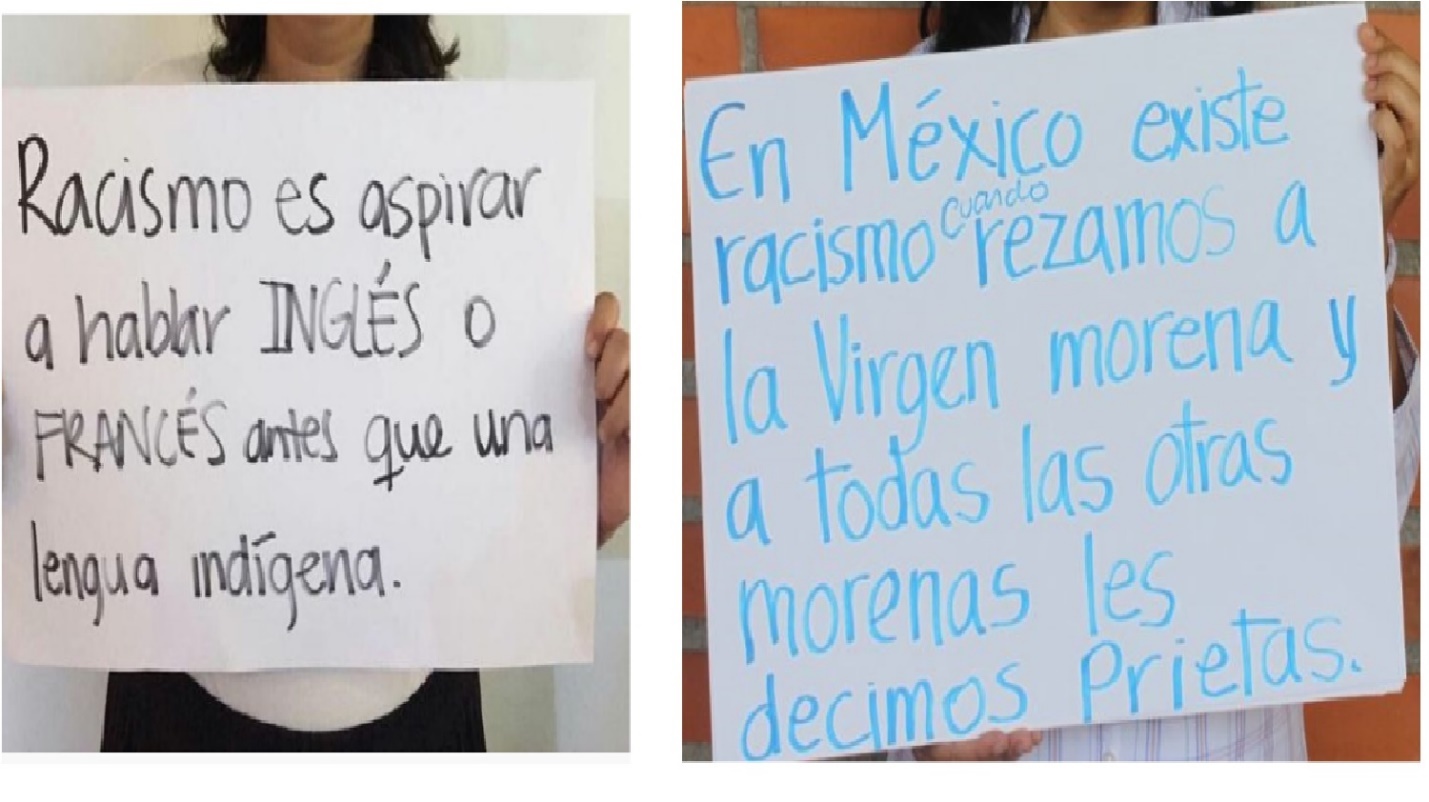
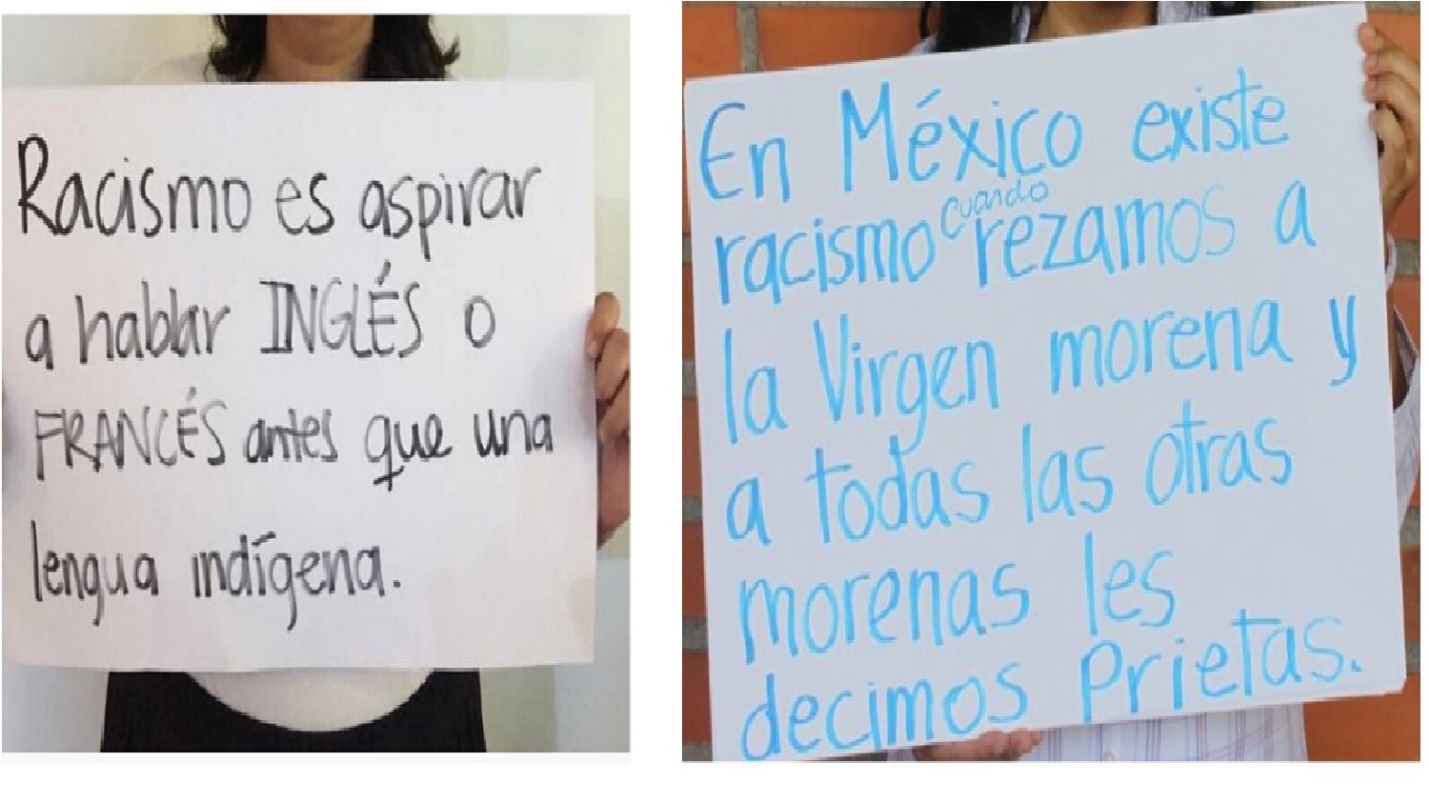
By way of illustration, Attinasi’s (1997) assertion that “the significance of meaning conveyed through speech merits careful analysis because language is socially pervasive and pointedly visible” (p. 282) provides a useful lens for understanding these dynamics. This same perspective underlies the work of Colectivo Copera, which seeks to make racism in Mexico more visible by examining how linguistic practices reproduce social hierarchies. Through a social media campaign (see Fig. 1), the collective invited the public to consider how language shapes perceptions of racial and class differences in Mexico. The responses illustrated the duality of the linguistic market (see Bourdieu, 1977) and showed how linguistic choices continue to index prestige and social positioning in contemporary Mexican society.
Building on this understanding of language as a marker of social power, the present study applies a Critical Discourse Analysis (CDA) framework (Fairclough, 2010; Van Dijk, 1993) to examine the social and linguistic practices of the comic character Cindy la Regia® as a representation of in-group identity in Mexican ‘elite’ society. Cindy is a popular fictional character from Mexican comics and (social) media, depicted as a young woman from Monterrey, Mexico belonging to a wealthy, upper-class family. Her character is known for blending English and Spanish in speech, adopting foreign cultural markers, and engaging in humorous exaggeration of so-called elite lifestyles. A CDA of Cindy’s linguistic practices highlights how her speech reflects patterns of code-mixing, prestige, and social distinction among privileged groups such as fresas and whitexicans. Considering this context, the following section provides a detailed description of Cindy la Regia®.
1.1. Cindy la Regia®
Ricardo Ariel Velderrain Castro, better known as Ricardo Cucamonga, created the comic character Cindy la Regia® in 2004. Cindy Garza (i.e., Cindy la Regia®) first appeared in the comic magazine Ponx and gained wider popularity in 2009 when Cucamonga launched the X (formerly Twitter) account @CindyLaRegia (Bautista Rojas, 2013), which currently has over 400,000 followers. Comics are defined as a medium of “juxtaposed pictorial and other images in deliberate sequence intended to convey information and/or to produce an aesthetic response in the viewer” (McCloud, 1993, p. 9). Cindy la Regia® serves as an example of this form, using sequential images and text to convey meaning and character. On her website, Cindy is introduced as la niña más cool de México [the coolest girl in Mexico] and la más fresa y una niña tipo bien [the preppiest and privileged girl]. According to Cucamonga, Cindy was inspired by one of his friends’ dating experiences and her aspiration to marry a wealthy man. The character’s popularity extended beyond comics with a feature film in 2020 and a Netflix series in 2023, which brought Cindy to a broader audience.
Frequently described as politically incorrect, Cindy la Regia® “is a reflection of the middle class’ aspirations and its frustrations” (Bautista Rojas, 2013, my translation). She resides in San Pedro Garza García, one of the wealthiest municipalities in Latin America, located in Monterrey, Nuevo León, Mexico, a state bordering the southern United States. Celso José Garza Acuña, a former Secretary of the Extension and Culture Department of the Autonomous University of Nuevo León, described the city as “the historical, contemporary expression of the great neoleonesian, regiomontanian, sampetrinian aspiration of cosmopolitanism” (Diario de Querétaro, 2018, my translation). San Pedro is home to high-income residential areas inhabited by soccer players, diplomats, and executives of multinational corporations, and its infrastructure and architecture evoke the impression of an American or European city rather than a Mexican one (Diario de Querétaro, 2018). As seen in the comic strips, Cindy is an upper-class emerging adult from San Pedro, depicted as a blonde character whose friends are also white. Her primary goal is to marry a wealthy, handsome, white man, while she simultaneously works as a writer. In her universe, Ricardo Cucamonga plays the role of her PR, assistant, and ghostwriter. Cindy is depicted as a wealthy girl who follows the standards of fresa women from the 1960s in Mexico (Maristain, 2013), representing those Mexican women whose main pursuit in life is to get married. She embodies a conservative persona both in behavior and style of dress, attends church regularly, and aspires to have a family of her own. Cindy lives with her sister Tiffany, who prefers to be called “Raven,” along with her father and mother. Her extended family, including cousins, aunts, and her grandmother, occasionally appears in the comic strips on Cindy’s website.
Although Cindy presents herself as an upper-class emergent adult, her father reveals in one of the comic strips that he works at la central de abasto (i.e., a food wholesale market), a job considered low prestige in Mexican culture. Cindy’s family also employs a housekeeper, stereotypically portrayed as a dark-skinned woman named María Xóchitl García. Interestingly, María is one of the most common female names in Mexico, with 2,611 women named María Hernández Hernández recorded in 2019 (Excélsior, 2014), while the name Xóchitl is of indigenous origin. The compound name María Xóchitl thus symbolizes the invisibility of the many women employed as housekeepers in Mexican households, who are often of indigenous descent (CONAPRED, 2011). This detailed portrayal of Cindy’s family and social environment underscores the complex intersections of class, race, and privilege in contemporary Mexico. It provides a foundation for understanding the social position and visibility of groups such as whitexicans and fresas, whose linguistic and cultural practices serve as markers of upper-class identity and social distinction.
1.2. ‘Whitexicans’ in Mexico
Social stratification has long been a sensitive topic in Mexican society, which historically resisted acknowledging class divisions despite clear socioeconomic hierarchies. In this context, representations in both traditional and new media have highlighted the cultural and linguistic mosaic of contemporary Mexico. One of the most notable emergent labels to describe these new representations is the neologism whitexican (a blend of the words white and Mexican), a term that captures not just perceived racial identity, but also class-based privilege mediated through language and lifestyle. According to Llamas-Rodriguez (2024), whitexican functions both as a satirical social media vernacular and as a heuristic for understanding broader struggles over class, race, and indigeneity in digital culture. “However, the term is related to (biological) phenotypes in a limited sense… It reveals socialized categories that highlight various forms of discrimination, including racism” (López García, 2025, p. 303) both in online and offline contexts.
Scholars like Mejía Núñez (2022) argue that the term whitexican is deeply linked to blanquitud, or light-skin privilege, as the term encapsulates symbolic whiteness (blanquitud) as an attribute, a social position, and a site of power. Blanquitud, in this discourse, is not just about skin color but about the social imaginaries and discourses of superiority that naturalize inequality. While Álvarez-Pimentel (2020) connects whitexican identity with conservative, religious, and pro-American discourses; whiteness in these contexts is subtly mobilized through appeals to European heritage, morality, and cultural proximity to the United States.
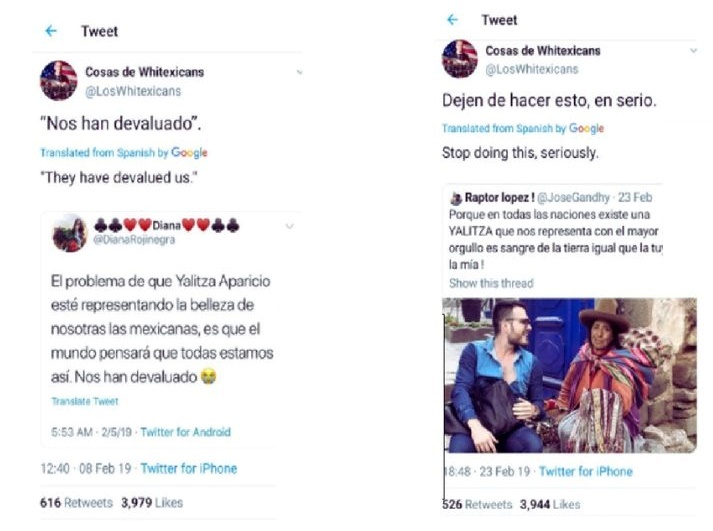
In terms of sociolinguistic behavior, whitexicans frequently engage in code-mixing between English and Spanish, a practice that signals cosmopolitan prestige and social distinction (Actualidad RT, 2019). In addition, Llamas-Rodriguez (2024) highlights that whitexican discourse, as seen in memes, political cartoons, and celebrity social media posts, reflects a vernacular whiteness that is aspirational and tied to Mexican elite identity. For instance, analyses of the X account @CosasdeWhitexicans further show that while posts are often sarcastic, they expose a lack of shared understanding about whiteness and privilege, revealing how language and discourse operate to reinforce social hierarchies (Mejía Núñez, 2022). Posts shared in the account frequently reference social groups or public figures, including Yalitza Aparicio, the Oscar-nominated protagonist of Roma, whose representation as an ideal of Mexican beauty contrasts with the whitexican persona and underscores broader social and cultural tensions in contemporary Mexico (see Fig. 2).
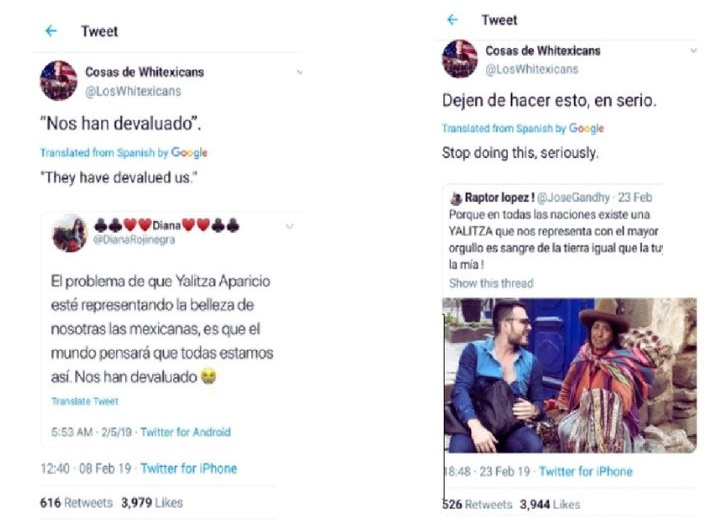
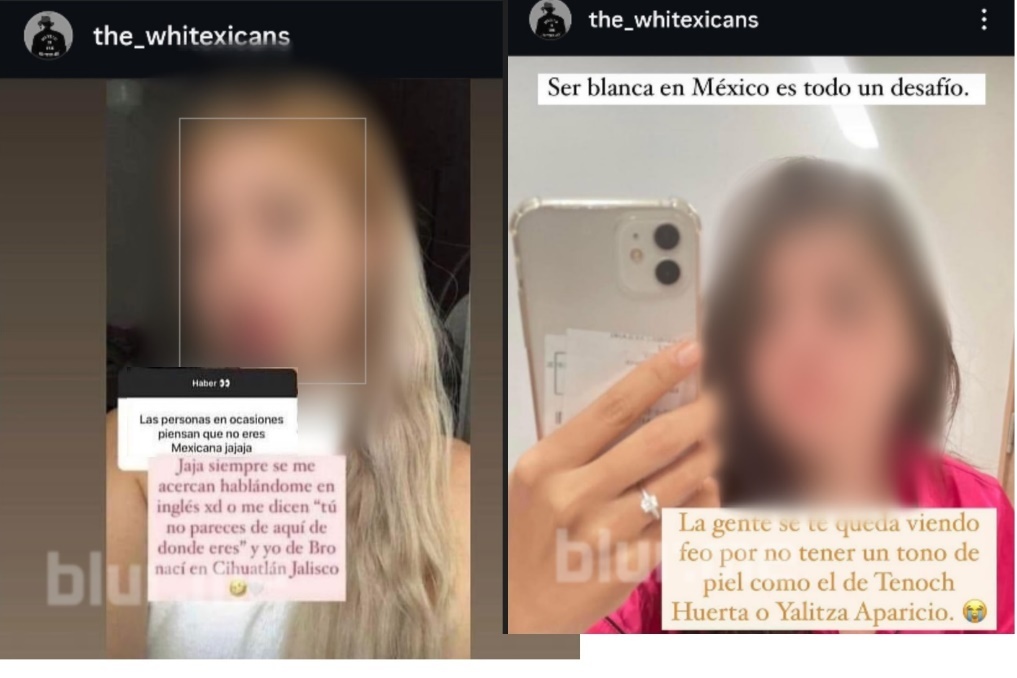
The tweets discussed above reflect the same social dynamics that Alfonso Cuarón (director of Roma) portrays in the film, highlighting structural inequalities in Mexico that disproportionately affect indigenous communities, often situated at the lowest levels of the social hierarchy. Similarly, in their Instagram account @CosasdeWhitexicans features discussions about skin color, evidencing both the prevalence of colorism in Mexico and the linguistic privilege of English compared with Spanish (see Fig. 3).
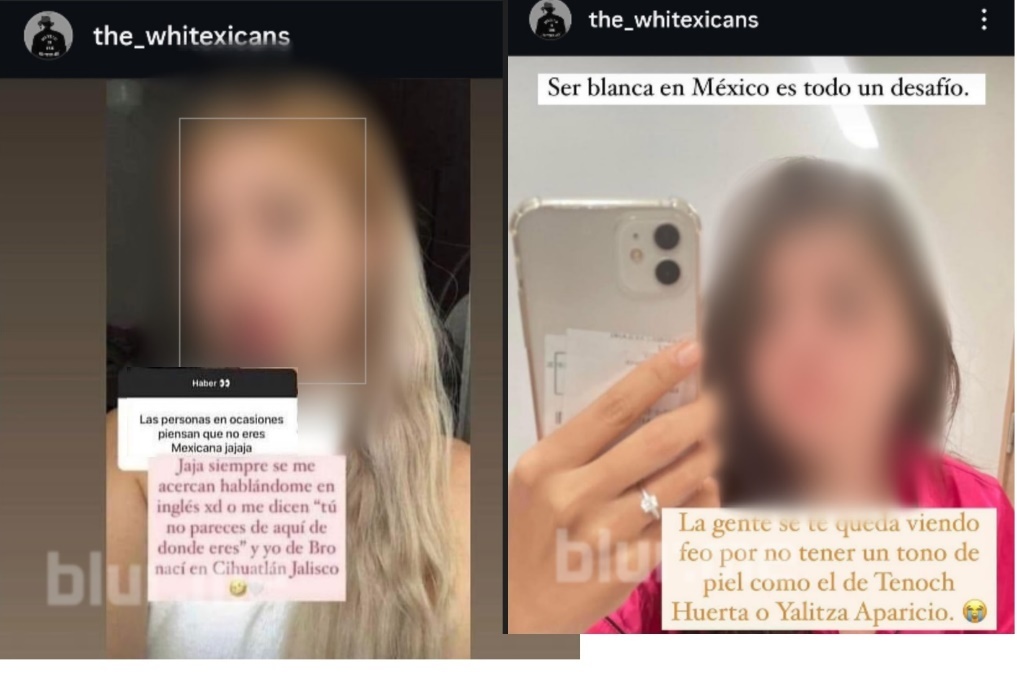
Additionally, recent narratives further suggest that blonde individuals can also face discrimination (i.e., reverse racism) in Mexico. Media productions such as the Netflix reality show Made in Mexico bring these social divisions into sharper focus. Mexico, a country of over 120 million inhabitants (INEGI, 2020), has more than 47 million people living in poverty (INEGI, 2025), highlighting the depth of inequality that shapes contemporary social life. Made in Mexico was widely criticized for illustrating these disparities by centering on the small group considered the ‘Mexican elite,’ presenting stereotypes such as “the agony of being a blue-eyed blonde in a mostly brown environment” (Hale, 2018, my translation). The paradox of Mexican pride expressed through the mixing of English and Spanish in daily interactions, along with the subtle judgments among the protagonists based on English proficiency (Escobar, 2018), reflected and reinforced social hierarchies in a country that has deeply internalized and continues to reproduce colonial social structures and values (e.g., López García, 2025).
In sum, whitexican is not merely a meme or social media label; it reflects deeper sociolinguistic practices, racialized power, and a contemporary elite identity shaped by language, class, and symbolic whiteness. However, prior to the emergence of the whitexican label, the term fresa was used to describe a Mexican social group that shares some traits with whitexicans, particularly regarding linguistic and cultural markers, although there are key differences that will be outlined below.
2.2. Fresas in Mexico
As mentioned above, Cindy la Regia® is described as la niña más cool de México y la más fresa, una niña tipo bien. In Mexico, the term fresa refers to a stereotyped social identity associated with people (often young) from economically privileged backgrounds who display a cosmopolitan, upper-class lifestyle. According to Holguín Mendoza (2018), fresas are marked by their distinctive sociolinguistic style, combining English and Spanish (i.e., code-mixing), using certain discourse markers, and embodying symbolic sociolinguistic capital in the way they speak. Fresa identity is tied to social refinement, consumer culture, and, importantly, whiteness as part of class performance. Fresas also draw parallels to Spain’s pijos. Both groups belong to upper- and upper-middle-class strata and frequently signal their status through conspicuous consumption, travel, and leisure activities (Ólafsdóttir, 2013; Tinat, 2014). Spanish pijos are typically Catholic, conservative, apolitical, and drawn from families that maintain professional traditions across generations. Similarly, Mexican fresas, influenced by American pop culture, perceive themselves as socially superior, often looking down on those considered nacos and favoring the trendiest venues. Fresas are further stratified according to social hierarchy (Castro Pozo, 2005). At the top are glamorous fresas, whose high purchasing power allows them to live in a reality removed from the general population. The second tier, light fresas, value people for their character rather than their possessions. The third tier includes rebels or alternative fresas, who reject the label even when surrounded by other fresas. At the base are fresa wannabes, who attempt to emulate the behavior, speech, and dress of their peers without comparable resources. Spanish pijos similarly maintain social distinction through conservative values, family traditions, and leisure practices that reinforce their status (Tinat, 2014).
Importantly, a defining feature of fresas’ identity is their speech. They extend words, stress final syllables, and use a distinctive lexicon, including güey [bro], ósea [I mean], neta [seriously], equis [never mind], and ash [disgusting] (Castro Pozo & Ortega Gutiérrez, 2004; Diccionario fresa, 1999; Nájera Espinosa & Ortiz Henderson, 2012; Recaredo, 2006). English words pronounced in Spanish, such as hiper sensible or ¡Está wow!, are also common, functioning as markers of in-group identity and social prestige (Castro Pozo & Ortega Gutiérrez, 2004; Ólafsdóttir, 2013). While code-mixing is sometimes stigmatized as a lack of proficiency (Hernandez, 2003), deliberate selection of one language over another signals social distinction for this group. Historical parallels, such as the perceived prestige of Spanish over Gallego in La Coruña, illustrate how language choices reinforce hierarchical structures (Kabatek, 1997). In this context, code-mixing is defined as the “embedding of various linguistic units such as affixes (bound morphemes) and words (unbound morphemes), phrases and clauses [from one language into another] that participants use in order to infer what is intended” (Bokamba, 1989, p. 278).
Although whitexicans and fresas are often associated with Mexico’s privileged sectors, the two labels operate differently in terms of social meaning, scope, and ideological weight. Both groups share aesthetic and linguistic practices linked to prestige, such as the incorporation of English, cosmopolitan consumer tastes, and participation in elite social networks (Holguín Mendoza, 2018; Martínez-Gómez, 2018). However, while fresa has traditionally functioned as a cultural stereotype tied to youth style, mannerisms, and class-indexed speech, whitexican has emerged as a more explicitly political and racialized term that critiques structural privilege, colorism, and the reproduction of whiteness as social capital (López García, 2025). In other words, fresa primarily characterizes a recognizable social persona, whereas whitexican names a broader socio-racial formation that exceeds fashion or linguistic affectation, calling attention instead to enduring hierarchies rooted in Mexico’s colonial past. Thus, although the two categories overlap in their association with elite lifestyles, they differ significantly in the kinds of social critique and power dynamics they index.
Having introduced the significance of examining cultural identity and social perception in contemporary Mexican society, it is crucial to situate Cindy La Regia® within existing scholarship. The following literature review explores research on youth identities, class-related stereotypes, and comic analysis, offering the theoretical and analytical tools necessary to understand how the character both reflects and critiques social norms in Mexico.
2. Literature review
Comics are more than entertainment; they are cultural texts that encode social values, stereotypes, and power relations. By combining CDA (e.g., Fairclough, 2010; Van Dijk, 1993) with multimodal analysis of comics (McCloud, 1993), it is possible to explore how characters such as Cindy la Regia® embody class aspirations, cultural ideals, and the dynamics of privilege in Mexican society. CDA provides a framework for examining not only what is communicated but also how social norms, identities, and inequalities are encoded in discourse. Comics, as a multimodal medium, combine visual and textual elements in deliberate sequences to convey meaning, create aesthetic effects, and represent social identities. Moreover, since the comic character under review is described by her own author as la niña más fresa de México, discussing studies on fresa and whitexican identities illustrates the construction of in-group identity and the social and linguistic practices associated with these groups. The present section will further discuss this scholarship.
2.1. Comics and Critical Discourse Analysis
Comics have been part of culture since the earliest times, combining words and images to convey stories. This interplay allows for complex and flexible meaning-making, even within the spatial constraints of the comic format (McAllister et al., 2001). Creators often rely on stereotypes to communicate messages quickly (Walker, 1994). Although captions and thought balloons can explicitly present themes or values, readers may interpret them in ways that differ from the author’s intentions. Comics can serve multiple purposes: they may act as oppositional culture, reinforce dominant ideologies, or embody contradictory ideological dimensions (McAllister et al., 2001).
Scholarship on comics has primarily focused on stereotypical representations (e.g., Lutz, 2009; Singer, 2002), comics as teaching tools (e.g., Barbosa Da Silva et al., 2017; Gower, 1995; Paré & Soto-Pallarés, 2017), and the ways comics communicate meaning (e.g., Carrier, 2000; McCloud, 1993). When comics portray stereotypes, issues of dominance, inequality, and power are often intertwined (see Lutz, 2009; Singer, 2002). In this vein, Van Dijk (1993) defines dominance as
the exercise of social power by elites, institutions or groups, that results in social inequality, including political, cultural, class, ethnic, racial and gender inequality. The reproduction process may involve such different ‘modes’ of discourse-power relations as the more or less direct or overt support, enactment, representation, legitimation, denial, mitigation or concealment of dominance among others (p. 250).
When social inequality exists, commands are not the only expression of dominance; conditions of legitimacy and social acceptability also play a central role in maintaining it (Fairclough, 2010; Van Dijk, 1993). CDA provides a framework for examining the discourse that underlies social hierarchies and power relations. Drawing on Van Dijk (1993) and Fairclough (2010), it is possible to explore how privileged social actors sustain their influence through language and discourse. Power is derived from “socially valued resources, such as wealth, income, position, status, force, group membership, education or knowledge” (Van Dijk, 1993, p. 254), and those with access to these resources often communicate across a wider range of contexts, genres, and audiences. Individuals with fewer resources typically interact within smaller circles of family, friends, or colleagues.
At the micro-level of speech, dominant discourses frequently operate unconsciously, influencing not only syntax, morphology, and phonology, but also intonation, lexical choices, syntactic style, rhetorical devices, and local semantic patterns, all of which can serve to reinforce existing social hierarchies (Van Dijk, 1993; Wodak & Meyer, 2009). Privileged actors often perceive their social position as legitimate, a perception shaped by automatic socio-cognitive processes that can lead to biased or prejudiced speech. The meaning of such statements is not fixed; it emerges through interpretation by both powerful and less powerful participants in interaction (Fairclough, 2010; Van Dijk, 1993). When speech departs from socially normative rules, it can function to exclude or diminish the participation of less powerful individuals, while the powerful may rationalize or overlook the inequality this produces. In these discursive processes, those with less power are frequently constructed in negative terms, whereas members of dominant groups are represented positively, reinforcing social distinctions and the legitimacy of existing hierarchies (Van Dijk, 1993; Wodak, 2015).
To make representations of social groups credible and persuasive, Van Dijk (1993) identifies several discursive strategies that guide interpretation and reinforce the influence of dominant actors. These strategies include presenting negative evaluations as logical consequences of factual information, using rhetorical figures such as hyperbole to exaggerate negative actions of others while minimizing or euphemizing one’s own, and selecting words that convey implicit positive or negative judgments. Additionally, storytelling techniques are employed to make events appear personally experienced and to provide detailed descriptions that enhance the plausibility of negative characteristics. Structural emphasis also plays a role, for example by placing the negative actions of others in prominent positions within headlines, leads, or syntactic structures, thereby foregrounding them in discourse. Finally, quoting credible witnesses, sources, or experts lends further authority to the representation. Together, these strategies shape interpretation and maintain social hierarchies by subtly guiding how audiences perceive the actions and characteristics of different groups.
2.2. In-group identities of fresas and whitexicans in Mexico
Research on socially privileged youth and elite cultural groups in Mexico highlights the ways language, appearance, and lifestyle function as markers of identity. Studies on fresas, such as those by Holguín Mendoza (2018) and Martínez-Gómez (2018), demonstrate that this group constructs social prestige through linguistic and cultural practices. For instance, using an ethnographic sociolinguistic approach, Holguín Mendoza examined three bilingual female social networks in the border cities of Ciudad Juárez and El Paso, analyzing the mixing of English and Spanish, intonation patterns, discourse markers, and lexical choices. Whereas Martínez-Gómez (2018) similarly employed ethnographic observation and sociolinguistic interviews with bilingual young adults from urban middle- and upper-class neighborhoods, analyzing speech patterns, code-mixing, lexical style, and hypercorrect pronunciation. The findings of both studies indicate that fresa identity is performed through a combination of linguistic style, stylistic markers, and consumer-oriented behaviors, reproducing social distinction and aligning with aspirational upper-class norms. Martínez-Gómez further emphasizes the variability of social meanings associated with fresa practices, showing that these behaviors are not only stereotyped by outsiders but also strategically employed by participants to negotiate in-group cohesion, class distinction, and social mobility. By foregrounding these practices, both studies illustrate how youth negotiate symbolic capital along class and perceived racialized lines, often using code-mixing to index their in-group identity.
In parallel, research on whitexicans extends this focus on elite identity to explicitly racialized and political dimensions. By way of illustration, Llamas-Rodriguez (2024) analyzed social media content, including satirical posts, political cartoons, and celebrity discourse, using qualitative discourse analysis to explore how whitexican functions as a heuristic category for understanding privilege, whiteness, and indigeneity in contemporary Mexican digital culture. His study highlights that code-mixing, particularly the frequent integration of English lexical items, phrases, and idioms into Spanish discourse, is a key marker of whitexican identity, signaling cosmopolitanism, elite status, and in-group belonging. Similarly, Mejía Núñez (2022) conducted a qualitative content analysis of user responses to the @CosasdeWhitexicans X account, showing that while humor dominates the posts, digital reactions reveal divergent perceptions of whiteness, social privilege, and linguistic practices, with code-mixing often serving as both a tool for social distinction and a point of critique. Finally, Álvarez-Pimentel (2020) situates whitexican identity within broader sociopolitical and historical contexts, linking unspoken ideals of whiteness to conservative cultural and religious norms. Using historical and discourse-analytic methods, his study demonstrates that whiteness in elite conservative circles operates as a moral and political standard, implicitly legitimizing social hierarchies and marginalizing darker-skinned and indigenous populations. Collectively, research on fresas and whitexicans highlights both the stylistic and structural mechanisms through which privilege is enacted and recognized in Mexican society, from micro-level linguistic practices such as code-mixing to broader cultural and racialized frameworks.
Building on the discussion of fresa and whitexican in-group identities, and guided by the principles of CDA, the present study is framed around the following research questions:
-
How does Cindy la Regia® convey her in-group identity through language and interactions?
-
How and in what contexts does Cindy la Regia® use code-mixing to index social identity and in-group membership?
-
How do the visual and narrative elements of Cindy la Regia® comics reinforce her social identity, in-group membership and the stereotypes associated with her character?
To systematically explore these research questions, this study adopts a mixed methodology that applies CDA to both textual and visual elements of the Cindy la Regia® comics. The following sections outline the data sources, analytical framework, and procedures employed to examine these phenomena.
4. Methodology
Building on the discussion of social identity, language, and privilege in contemporary Mexican society, this study adopts a mixed methodology to examine the comic character Cindy la Regia®. Guided by the principles of CDA (Fairclough, 2010; Van Dijk, 1993), the approach focuses on how Cindy’s language and interactions reflect broader social hierarchies and linguistic practices. Both textual and visual elements of the comics are analyzed to explore how speech patterns, lexical choices, and code-mixing practices function as markers of social identity and in-group membership. This methodology allows for an in-depth examination of the ways in which humor, stereotypes, and narrative strategies convey social aspirations, distinctions, and cultural norms. The following sections outline the data sources, coding procedures, operationalization of variables, and analytical framework employed to systematically address the research questions.
3.1. Data collection and analysis
The present study analyzed a total of 271 comic strips from Cindy la Regia®’s official website (cindylaregia.com[1]). Sixteen strips were excluded because Cindy either did not appear or did not verbally interact with other characters, her audience, or herself, resulting in a final corpus of 255 strips. Across these strips, Cindy engaged in 310 interactions with various interlocutors. Strips from her social media accounts, books, or weekly Milenio[2] contributions were not included, as many lacked communicative interactions or were inaccessible.
To operationalize variables for analysis, two primary categories were defined: linguistic practices and social interaction context. Linguistic practices were coded for speech patterns, lexical choices, and code-mixing, with any English-origin elements embedded within Spanish utterances classified as instances of code-mixing. For example, in Sí. So… ¿Qué esperas gooey? ¡Aplícate! and OMG, es que tú eres tan sabia abuelita ¡Me quedé frozen!, the words so, OMG, and frozen were coded as English-origin insertions. Other variables, such as the presence of humor, exaggeration, or derogatory language, were annotated to capture stylistic strategies linked to in-group identity and social distinction. Across the corpus, English utterances were individually coded, with multiword expressions such as so sad, Dear Daddy God, or Mexico rocks treated as single units. This analysis made it possible to measure the frequency, distribution, and communicative functions of English within Cindy’s speech, thereby identifying how code-mixing operates as a stylistic resource for indexing privilege, cosmopolitanism, and in-group identity.
Social interaction context was coded according to the type of interlocutor appearing in each comic strip. Categories included friends, family members, fans, workers, shop assistants, famous people, and Cindy herself or her imaginary audience. Interactions with shop assistants and street vendors were coded separately, as these exchanges often reflected differential social behaviors and attitudes. Famous people included presidents, artists, fashion designers, television presenters, and reporters, while workers encompassed janitors, teachers, customs agents, and windshield cleaners. Interactions with herself or her audience were also identified to capture moments of self-address or internalized reflection.
The coding process was carried out iteratively. Initially, a preliminary codebook was developed based on social interactions and linguistic practices. Each comic strip was reviewed multiple times to ensure accurate identification of linguistic, visual, and interactional variables. Codes were then organized to detect patterns in code-mixing, lexical choices, and social positioning. These coding strategies enabled a comprehensive examination of how Cindy la Regia® enacts and communicates her in-group identity, privileges, and social distinctions across the corpus, which are discussed in detail in the following section.
4. Results
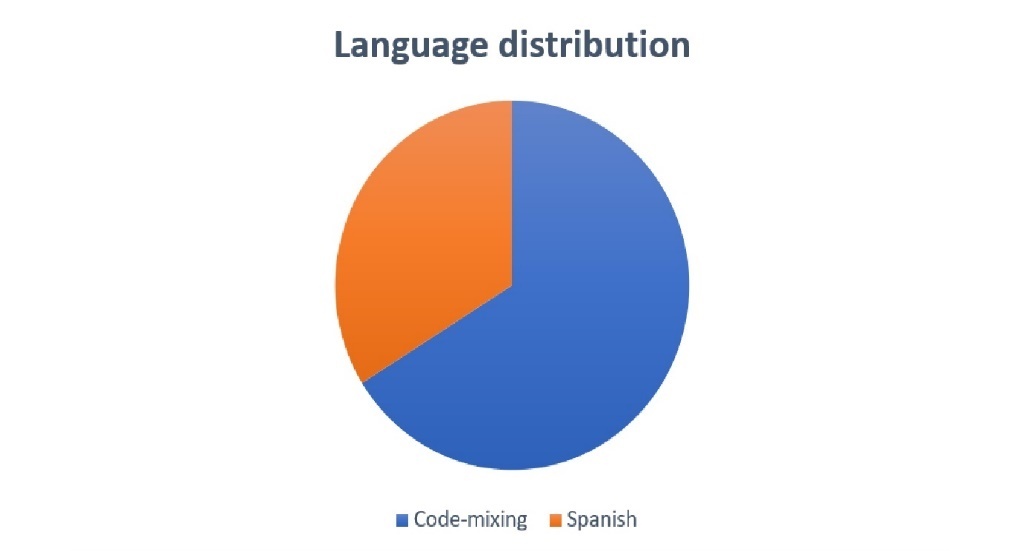
This section presents the findings of the analysis of Cindy la Regia®’s linguistic and social interactions, with a particular focus on how her speech reflects the identity and practices of Mexico’s privileged youth. The analysis examines both the frequency and context of her interactions, as well as her use of code-mixing as a marker of in-group identity and social distinction. In the present corpus, Cindy engaged in a total of 310 interactions. Of these, 205 included instances of code-mixing, while 105 were entirely in Spanish (see Fig. 4). The results are organized to highlight patterns in her use of language across different interlocutors, the prevalence of code-mixing, and the ways in which Cindy’s interactions mirror the social hierarchies, behaviors, and values of the fresas community. These findings provide insight into the interplay between language, identity, and social stratification in contemporary Mexican society.
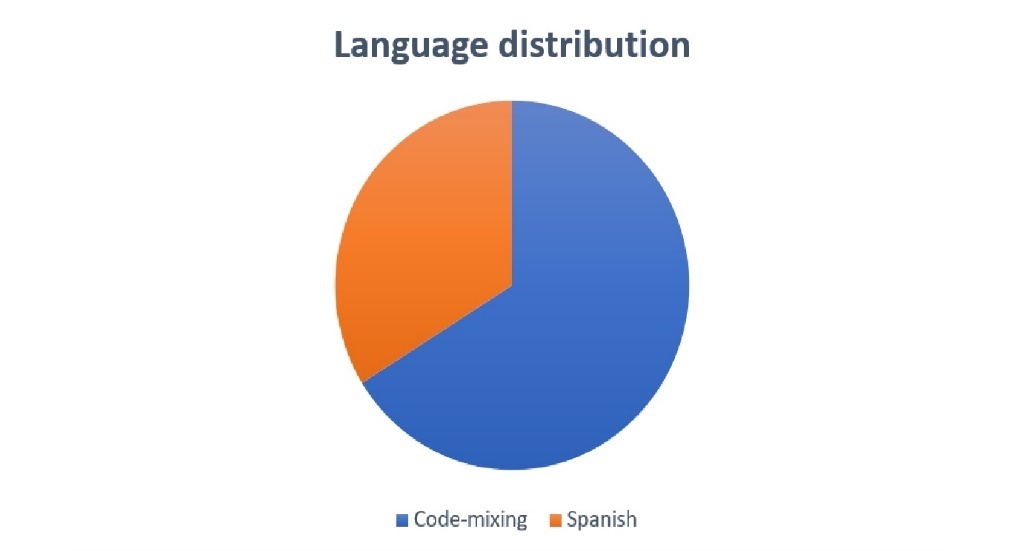
As a general pattern, more than half (66.12%) of Cindy’s utterances incorporated code-mixing, and a total of 378 English units were coded. The most frequent English token was hello, also written as jelou, accounting for 53 instances (14%). This was followed by OMG, occasionally rendered as Omaigad (9%) in the earliest comic strips, and cool (7%). In terms of discourse markers, wait appeared most frequently (2%), while the Spanish equivalent espera or similar markers were never used.
In addition, Cindy consistently expresses affection and politeness in English, using phrases such as I love you, love you, or love ya, and please, while Spanish equivalents like te quiero, te amo, por favor, por fis, or por fa were absent. References to God appear as Daddy God. Within her family, Tiffany, her sister, is nicknamed gordi-sister, combining the Spanish word gorda (fat) and the English word sister, while Cindy never uses the Spanish word hermana. This pattern extends to her parents, whom she calls daddy and mommy. In interactions regarding her housekeeper Mary, Cindy uses maid, whereas her friends call her sirvienta (servant). Conversely, she consistently uses Spanish when referring to her cousins, grandmother, and aunts, employing primos/primas, abuelita, and tía, respectively.
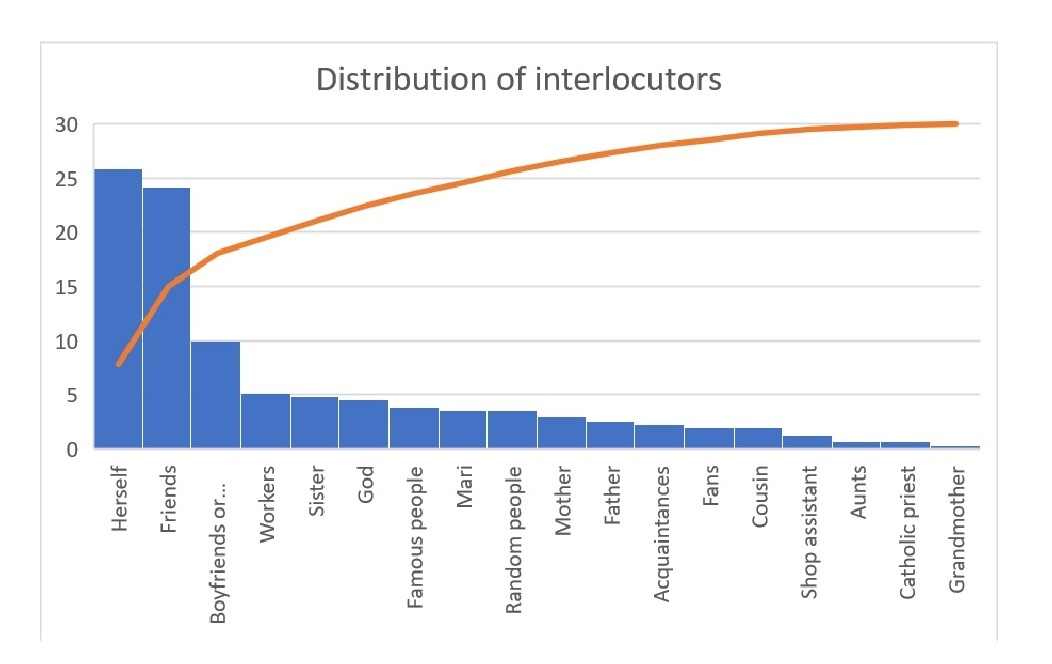
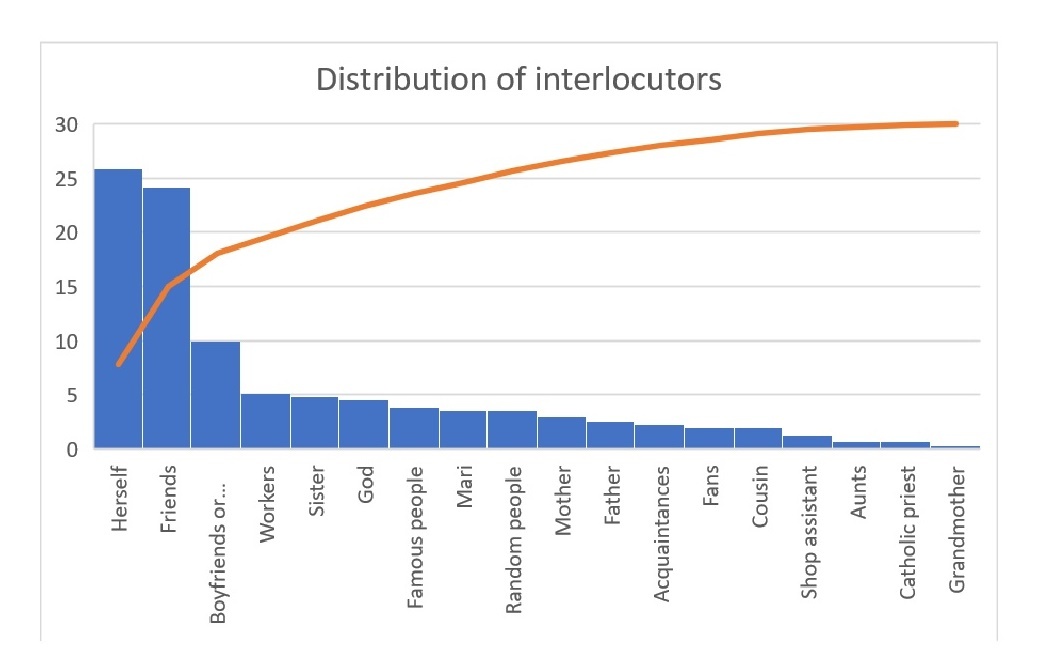
As shown in Table 1, the distribution of Cindy’s interactions across interlocutors reveals clear patterns in the social world constructed in the comic. The most frequent interaction category involves Cindy speaking to herself or addressing her audience, indicating that self-reflection, internal monologue, and direct audience engagement are central narrative devices in the strip. Conversations with friends make up the second-largest proportion, showing that Cindy’s social identity is primarily expressed within her peer group, which aligns with her characterization as a fresa embedded in a youth-oriented and privileged social environment. Interactions with romantic partners also play a meaningful role, emphasizing the importance of affective and relational themes in the construction of her character. In contrast, Cindy engages far less frequently with individuals outside her social class, such as workers, shop assistants and street vendors. Although these interactions are limited, their presence is significant because they often highlight class-based attitudes and social hierarchies. Family interactions, including those with her mother, father, sister, and other relatives, represent a smaller portion of the corpus, suggesting that the narrative centers more on Cindy’s autonomy and her friendships rather than on family life. Cindy’s exchanges with figures of symbolic or cultural authority, such as God, famous people, or a Catholic priest, add further layers of social commentary and humor, often exaggerating elite aspirations or moral dilemmas. Overall, the distribution of interaction types (see Fig. 5 ) shows that Cindy’s social and linguistic practices are mainly shaped within elite peer contexts and through self-directed discourse, while less frequent interactions with lower-status individuals expose the classed and hierarchical dimensions of her portrayal.
As previously stated, Cindy interacted with her interlocutors using either Spanish or a mix of English and Spanish. The frequency with which she employed Spanish or code-mixing varied depending on the interlocutor involved. For analytical purposes, her interlocutors were categorized into three main groups: 1) Family, which included her mother, father, sister, cousins, God, grandmother, and aunts; 2) Friends and romantic relationships, encompassing friends, boyfriends, famous people, fans, herself or her audience, and acquaintances; and 3) Workers, which comprised Mary, shop assistants, other workers, random people, and the Catholic priest. The distribution of Cindy’s interactions, showing the relative use of Spanish or code-mixing with each group of interlocutors is detailed in Tables 2, 3, and 4. These tables provide a foundation for examining patterns of language use across different social relationships, highlighting how Cindy’s linguistic choices reflect social identity, status, and in-group dynamics.
As previously stated, Cindy’s interactions with family members reveal clear patterns in her use of Spanish and code-mixing that reflect both intimacy and social hierarchy (see Table 2). Within this group, she most frequently addresses her sister, Tiffany, with the English-Spanish compound nickname gordi-sister, while she never uses the Spanish equivalent hermana. Similarly, her parents are consistently referred to as daddy and mommy, rather than papi or mamá. References to her housekeeper, Mary, follow a similar pattern: Cindy uses maid, whereas her friends employ the Spanish term sirvienta. By contrast, Spanish remains the dominant language when referring to extended family, including her cousins (primos/primas), grandmother (abuelita), and aunts (tía). These choices indicate that Cindy strategically employs English to mark closeness, authority, or social distinction within her immediate household while maintaining traditional Spanish terms for relatives who occupy more conventional familial roles, reinforcing both social hierarchies and in-group identity. Interactions with her family accounted for 17.09% of the total interactions in the analyzed corpus. Although her sister and God were the most frequent individual interlocutors within this group, Cindy predominantly code-mixed when interacting with family overall (see Table 2). Among the seven interlocutors in this category, only her mother and grandmother consistently engaged with Cindy using code-mixing, sharing her concern and desperation to marry a wealthy man (see ex. 1 & 2).
-
Grandmother: ‘Y recuerda hijita, cuesta lo mismo enamorarse de un pobre que de un rico. Piénsalo, ¡eh!’
Cindy: ‘OMG, es que tú eres tan sabia abuelita ¡Me quedé frozen!’
Grandmother: 'Sí. So… ¿Qué esperas gooey?¡Aplícate!
-
Cindy: ‘No wee, ¡Hubieras visto al novio de smoking! ¡Jelou! Tipo todo marrano y así’
Mother: ‘Pues yo lo que vi fue a los compadres felices porque su hija se casó bien ¿Cuándo, diosito, voy a sentir lo mismo?’
As shown in Table 3, friendships and romantic relationships accounted for the most frequent interactions across the entire corpus, representing 68.06% of Cindy’s total interactions. Unsurprisingly, this category includes her most common interlocutors: friends, boyfriends or dates, and herself or her audience. Overall, code-mixing was slightly more frequent than Spanish in this group, occurring in 65.87% of interactions. Cindy regularly code-mixed when interacting with friends, who themselves also employed code-mixing, and with her boyfriends or dates. Notably, Cindy’s fans, who rarely appeared in the comic strips and usually communicated via email, and famous people, were exceptions to this pattern. Most characters in this category were blonde or white, and Cindy displayed clear social preferences; for example, when she went on a blind date with a non-white man, she rejected him unless he was wealthy (see ex. 3).
-
Cindy to her friend: ¡Goeeey! ¡Estoy viendo el Facebook del date que me hiciste! ¡Está súper prieto, ¿no?
Friend: ¡Cindy! ¿Qué te pasaaa! ¡Tonta! ¡O sea! ¿No sabes que su papá es dueño de las joyerías Megagold?
Cindy to her date: ¡Tengo que decirte! ¡Amé tu bronceado mediterráneo, goeeey!
Cindy’s interactions with friends, boyfriends, famous people, fans, herself or her audience, and acquaintances demonstrate a complex use of code-mixing that highlights peer affiliation, social prestige, and personal identity. With friends, she frequently blends English and Spanish in phrases such as OMG, estás tan linda or ¡Está wow! to convey emotion and reinforce group membership. Romantic interactions similarly employ English terms of affection, including love you or sweetie, signaling intimacy and contemporary cultural alignment. When addressing herself or her audience, Cindy sometimes communicates entirely in English, creating a performative layer that positions her as both narrator and participant in the comic universe. Interactions with famous people and fans also incorporate English expressions, reflecting a desire to align with globalized cultural symbols and high-status interlocutors. Across this group, code-mixing functions not only as a linguistic strategy but also as a marker of in-group identity, social aspiration, and relational closeness, illustrating how Cindy navigates and performs the social norms of Mexico’s privileged youth.
Interactions with workers were the least frequent in the entire corpus, representing 14.19% of Cindy’s total interactions (see Table 4), although this was only 3.10% less than her interactions with family. Most workers, with the exception of the priest and a shop assistant who used to be Cindy’s friend, were portrayed as dark-skinned, and they were the primary targets of Cindy’s insults. Words such as naco (i.e., without class), gata/o (i.e., a derogatory term for a person in a service role), and prieto (i.e., pejorative term for dark-skinned people) frequently appeared in her speech during interactions or references to people in this group (see ex. 4). Cindy’s interactions with workers, including Mary, shop assistants, other workers, random people, and the Catholic priest, reveal a distinct pattern of language use that underscores social hierarchy and differentiation. As noted before, with Mary, her housekeeper, Cindy consistently uses the English term maid, while her friends refer to Mary as sirvienta, signaling Cindy’s perception of authority and control within this relationship. Similarly, shop assistants and other service workers are addressed using English or code-mixed expressions, reflecting a combination of social distance and playful condescension. Random street encounters and interactions with workers are less frequent but maintain this tendency to mark social boundaries through language choice. The Catholic priest is addressed formally yet occasionally in code-mixed speech, illustrating Cindy’s selective application of English to indicate prestige or assert individuality. For instance, in her interaction with a mechanic (see ex. 5), her use of English expressions such as Daddy, help, and frozen, along with exaggerated dramatization (i.e., ¡Se murió feíto la llanta!) and the term gato to reference the mechanic, indexes the prestige and frivolity associated with fresa speech, while the mechanic’s repeated use of güerita highlights how whiteness is central to her social positioning. Her reference to a wedding dress, wedding venue brochures, and Forbes magazines in her trunk further underscores her immersion in elite culture. Collectively, these patterns demonstrate how language operates as a social tool, reinforcing Cindy’s position within the privileged hierarchy and distinguishing her interactions with those perceived as occupying lower social strata.
-
Dark-skinned man to Cindy: ¡Heeey! ¡Guapaaa!
Cindy to him: ¿Pero cómo te atreves, naco, gato, igualado y acosador?
Light-skinned man to Cindy: ¡Eh! ¡Guapa! ¡Acá!
Cindy to light- skinned man: ¡Aaay, niño! ¡Te pasas de galante, goeeey!
-
Cindy to her dad over the phone: Daddy! ¡Se me ponchó una llanta y me quedé tirada! ¿Qué hago? ¡Tipo, help!
¡Ok, daddy lindo! ¡Yo espero a que llegue!
Mechanic: ¡Servicio Automotriz! ¿Qué problema tiene, güerita?
Cindy: ¡Se murió feíto la llanta!
Mechanic: ¿Dónde está su gato, güerita?
Cindy: ¡Lo estoy viendo!
Mechanic: …¡El aparato para levantar el auto!
Cindy: ¡Aaaah! ¡Cheque en la cajuela!
Mechanic: ¡Mmmmm! ¡No, güerita! ¡No lo veo por ningún lado!
Cindy: ¡Ahí está, señor! ¡Mueva el vestido de novia, el folleto de salones de boda y las revistas de Forbes! ¿No lo ve?
Furthermore, Cindy and her mother reproduce the racialized, class-based hierarchies through discursive strategies that naturalize dominance while presenting themselves as culturally appreciative. In dialogue 6, for example, Cindy enthusiastically praises Mary for her Día de Muertos altarcito and refers to las tradiciones mexicanas as “cool,” yet her comment that los inditos son todos puros essentializes Indigenous identity, framing Mary as spiritually exotic rather than as an equal. This further exemplifies negative other-presentation masked as admiration, in which out-groups are reduced to stereotypical traits while the speaker maintains positive self-presentation. Cindy’s commands (e.g., ¡Llévate las cositas!) and the image of Mary carrying all the shopping bags reinforce an asymmetric power relation, typical of elite households. The visual punchline of Mary performing a ritual on a doll of Cindy functions as a counternarrative exposing the resentment produced by these everyday micro-acts of dominance. In addition, in dialogue 7, Cindy’s fresa-style performance (i.e., ¡Bh-ruto, goeey!) frames her mother’s art party as an event of elite cultural capital, while her mother praises Diego Rivera’s celebration of el México indígena as lo nuestro, engaging in a whitexican discourse that romanticizes indigeneity in the abstract. Yet this aestheticized admiration is immediately contradicted by her demeaning treatment of María Xóchitl (e.g., ¡Apúrate, niña! ¡Nomás no te haces gente!) which exemplifies explicit dehumanization and the everyday reproduction of social inequality. Together, these dialogues show how elite characters mobilize code-mixing, cultural pride, and racialized language to uphold a social order that values Indigenous culture as heritage while subordinating Indigenous people in daily interactions.
-
Cindy to Mary, who is carrying all shopping bags: ¡Goeeeey! ¡Vengo muerta del súper! ¡Me traje toda la tienda!
¡Ok! ¡Es todo, Mary! ¡Llévate las cositas que me pediste para tu altarcito!
Mary to Cindy: ¡´Chas gracias, Cindy!
Cindy to herself: ¡Mary mi vida! ¡Cocha! ¡Va a hacer su altar de muertos! ¡Goeeey! ¡Qué cool las tradiciones mexicanas! ¡Las amo! ¡Aparte los inditos son todos puros! ¡Soy fan de su onda! ¡Bien espiritual!
Mary performing a voodoo ritual on a doll representing Cindy:¡Siuachichi Istatik Cindy kuitlatl!
-
Cindy to her audience: ¡Bh-ruto, goeey! ¡Mi mami hizo una fiesta para mostrar su colección de arte!
Cindy’s mother to her guests: ¡…Y este Rivera muestra el amor por el México indígena! ¡Lo nuestro!
Her mother’s friend: ¡Sublime! ¡Qué lindo es el arte!
Cindy’s mom: ¡Y es que la gente no valora el verdadero México! ¡Nuestros tesoros! ¡No respetan esas grandes raíces!
Friend: ¡Cuan cierto!
Cindy’s mom to Mary: ¡Mary Xóchitl! ¿Qué pasa con las copas? ¡Apúrate, niña! ¡Nomás no te haces gente!
Additionally, dialogue 8 illustrates how Cindy uses language to construct her in-group identity as a privileged young woman from San Pedro while reinforcing classed and racialized hierarchies. In the following school scene, Cindy again foregrounds whiteness by emphasizing that Cinderella was rubia y europea y toda cute, and she openly demeans the children by stating she sees them más bien de chachas del reino, reproducing colorist and class-based hierarchies. When reprimanded, she reframes her discriminatory behavior as benevolent, claiming she was mejorando la educación, a discursive move that is identified as a typical strategy of dominant groups seeking to maintain positive self-presentation. This example shows how Cindy’s code-mixing, stylistic choices, and interactions with darker-skinned characters consistently reinforce elite identity and social inequality.
-
Cindy is reading Cinderella to a group of dark-skinned children at a public elementary school: …¡Y al ponerle la zapatatilla, Cenicienta se transformó en la hermosa princesa que habían estado buscando! …¡Y se casó con el príncipe encantado! …¡La llevó a su hermoso castillo y la trató como a toda una reina! ¡Y fueron muy felices por súper siempre, goooey!
¡Claro que Cenicienta era rubia y europea y toda cute! ¡No se ofendan, pero yo a ustedes las veo más bien de chachas del reino! Hello? Ha ha ha ha!
Cindy responds angrily to the teacher when she is instructed to leave the school: ¿Ay, queeeé? ¡Eso me pasa por tratar de ayudarles a mejorar la educación en las escuelas públicas! ¡En serio que cero cool! ¡Bye con eso, goeey!
In addition to her attitude toward dark-skinned people, Cindy also displayed social distancing based on occupation. For instance, an old friend, who was light-skinned and used the same code-mixed expressions as Cindy (e.g., goey, jelou), suddenly became the target of Cindy’s condescension when she discovered that the friend worked at the store where she was shopping. Cindy’s behavior shifted immediately: she became distant and even used formal commands to request that her former friend show her a purse (see ex. 9). This example illustrates how Cindy enforces social hierarchy not only through language and ethnicity but also through perceived social status and occupational prestige, reinforcing her position within the privileged hierarchy of San Pedro’s youth. At the same time, her discriminatory behavior highlights the gap between institutional directives and lived social practices (see ex. 10).
-
Friend to Cindy: ¡Cindyyyy! ¡Años de no verte, Goey! ¡Jelooou!
Cindy: ¡Elenaaaa! ¡No te veía desde la prepa! ¿Qué ha sido de tu vida, amiga?
Friend: ¡Trabajo en esta tienda!
Cindy: ¡Ah!
Cindy: ¡Muéstreme esa bolsa del aparador, señorita!
-
Cindy and her light-skinned friend notice a sign on a boutique wall: En esta boutique no se discrimina por su condición social…
They look closely: …Para eso están los precios.
Additionally, in the following dialogues (see ex. 11 & 12), Cindy employs discourse strategies that reproduce racialized and class-based hierarchies while performing an elite in-group identity. In dialogue 11, she rejects the American man’s remark, Tú no pareces mecsicana, as ignorant, yet simultaneously treats it as a compliment, revealing the internalization of symbolic whiteness and positive self-presentation. Her defense of Mexico through references to luxury stores, corporate buildings, and primer mundo museums ties national value to elite spaces, while her code-mixing (e.g., right?, hello?) indexes the cosmopolitan prestige characteristic of privileged youth. Similarly, in dialogue 12, Cindy again frames “not looking Mexican” as both racist and flattering, and her dismissive reference to paisanitos who arruinan el shopping exemplifies negative other-presentation that diminishes darker or working-class Mexicans. Her strategic use of English when addressing two dark-skinned people, along with her acknowledgement that she prefers to poner cara de extranjera in the mall, further reveals how she uses linguistic style and foreignness to distance herself from out-groups, even when they share the same national origin. Together, these dialogues show how Cindy negotiates, enacts, and benefits from whitexican and fresa ideologies by combining code-mixing, whiteness, and classed discourse to naturalize social inequality while reinforcing her own privileged position.
-
A white, American man to Cindy: From Mexico, right? ¡Tú no pareces mecsicana!
Cindy angrily replies to him: What?? ¡Me choca que todos los gringos siempre salgan con ese comentario! ¿Seguro crees que en México andamos en burro, right? ¡Para nada, somos un país avanzado también! ¡Tenemos tiendas de lujo, corporativos y museos de primer mundo! Hello? ¡Grrr! ¡Y estoy tan enojada que no te voy a agradecer el piropo que me hiciste!
-
Cindy to her audience at the mall: Una vez un inglés me dijo que no parecía mexicana. Me molesté muchísimo por su visión racista y luego le di las gracias por el cumplido… ¡Goeey! ¿Por qué tanto Mexican en Houston? ¡Te arruinan el shopping!
Cindy to two dark-skinned people: Excuse me… please.
Cindy angrily says to herself: … Cuando ando en el mall y está lleno de paisanitos, prefiero poner cara de extranjera…
Finally, the following dialogues (see ex. 13 & 14) reveal how discriminatory discourses circulate between Cindy’s mother, Cindy, and Mary, showing how socialization sustains racialized and class-based hierarchies. In dialogue 13, Cindy’s mother addresses Mary with infantilizing commands and moralizing comments about her appearance (e.g., ¿Qué son esas ojeras? ¡Te me estás maleando muchacha!), a pattern that exemplifies dominant-group authority, positive self-presentation, and negative other-presentation through judgments framed as concern. Mary responds with socially stigmatized linguistic forms (e.g., retemal de la salú, dispénseme, si viera), which index her lower socioeconomic position and contrast sharply with Cindy’s and her mother’s fresa-style code-mixing. When Cindy later visits the taquería Mary mentioned, she mirrors her mother’s discourse by rejecting the space as feíto and expressing fear of being seen there, an example of how discriminatory attitudes are learned, reproduced, and normalized across generations. Most remarkably, Mary’s own phone conversation (see ex. 14) shows how she has internalized these hierarchical discourses: she insults another woman as naca, mocks her clothing, and even adopts fresa-like expressions (e.g., gueey, cañón) to elevate herself socially. Her admiration of elite media figures and her complaint that the patrona does not let her talk a gusto further reveal her aspiration to participate in the prestige norms of Cindy’s world while still being constrained by her subordinate role. Importantly, the description of Armando’s cousin as someone who la bajaron del cerro a tamborazos perpetuates the negative representation of Indigenous people as uneducated, Non-Western dressed. Thus, these interactions demonstrate how linguistic practices, social positioning, and in-group aspirations intersect, with discriminatory ideologies flowing from Cindy’s mother to Cindy and from Cindy to Mary, who both resist and reproduce them in her attempt to negotiate status within an unequal social structure.
-
Cindy’s mom to Mary: ¡María Xóchitl García! ¿Qué pasó? ¿Por qué no viniste ayer, niña?¿Y qué son esas ojeras? ¡Te me estás maleando muchacha! ¿Verdad?
Mary: ¡Ay seño! ¿Cómo cree? ¡Fue por mi hermana, la menor! …¡Y es que anda retemal de la salú la pobrecita! ¡Dispénseme!
Cindy’s mom: ¡Virgen santa! ¡No sabía!
Mary: ¡Sí, doña! ¡Le dieron las amibas por andar comiendo en la calle! ¡Pero bien feo! ¡Si viera!… ¡Bajó como 10 kilos en 2 semanas!
Cindy speaking to her mom at the taquería Mary had mentioned: ¡Ay mami! ¿Por qué me trajiste a este rumbo tan feíto? ¡Qué oso si nos ve alguien! Hello?
Cindy’s mom to her: ¡Cállese y cómase sus tacos!
-
Mary speaking over the phone: …Y la estábamos pasando súper bien, ¡hasta que llegó la prima de Armando!
¡Aaaargh! ¡Maldita naca, te juro que la odio!
¡Me daba oso que la vieran dando la vuelta con nosotras! ¡Obvio la traté súper mal!
…¡Ay! ¡No soy mala! ¿Qué no la has oído hablar? ¡Es bien nacaaa! ¡Cañón!
¡Y luego cómo se viste! ¡Parece que la bajaron del cerro a tamborazos! ¡Qué horror!
¡Gueey! ¡Estoy viendo a Danna Paola en la tele! ¡No entiendo porqué le gusta a la gente! ¡Está bien fea y no tiene clase! ¡Vieja naca!
¡Ja, ja, ja! ¡Ay, nomás mírala! ¿A poco, no?
¡Oye! ¡Te marco al rato! ¿Sí?…
…¡Porque la @&$% patrona no me deja hablar a gusto, manita!
Cindy yelling at Mary: ¡MARY! ¡MARY! ¿dónde andas, niña?
Taken together, these findings demonstrate that Cindy la Regia’s® linguistic choices and interactional patterns function as a consistent performance of elite identity, one deeply intertwined with the racialized and class-based hierarchies that structure Mexican society. Her frequent use of English and code-mixing, present in over 66% of her utterances, operates as a symbolic resource through which she signals cosmopolitanism, aligns herself with the norms of fresas and whitexicans, and distances herself from those she perceives as socially inferior. These linguistic practices vary systematically depending on the interlocutor, highlighting how Cindy mobilizes language to index intimacy, superiority, or disdain. Interactions with workers, darker-skinned individuals, or perceived lower-class characters reveal patterns of condescension, discriminatory framing, and negative other-presentation, while exchanges with peers and family reflect positive self-presentation and in-group solidarity. Examples in which she treats “not looking Mexican” as both an insult and a compliment, or adopts a foreigner persona in public spaces, reinforce how symbolic whiteness and aspirational class identities shape her worldview. Overall, the results show that Cindy’s discourse reproduces and naturalizes the privileged position of Mexico’s upper-class youth, mirroring real sociolinguistic practices associated with both fresas and whitexicans and illustrating how humor and stylized language can function as vehicles for maintaining and/or mocking social inequality.
5. Discussion
The analysis of Cindy la Regia® demonstrates how linguistic practices, visual cues, and stereotyped interactions converge to construct an exaggerated yet recognizable portrayal of Mexico’s privileged youth. While Cindy was originally described by Cucamonga as a fresa, her discourse and social positioning strongly align with what later became known as the whitexican identity, a term that emerged years after the character was created but resonates with her aspirational whiteness, cosmopolitan affect, and classed worldview (López García, 2025; Mejía Núñez, 2022). As studies on fresas show (Castro Pozo & Ortega Gutiérrez, 2004; Holguín Mendoza, 2018; Ólafsdóttir, 2013), Mexican elite youth frequently employ English and stylized speech to index sophistication, privilege, and social distinction. Research on whitexicans further demonstrates how whiteness, foreignness, and aestheticized cosmopolitanism function as symbolic capital, shaping perceptions of identity, belonging, and superiority in digital and offline spaces (Álvarez-Pimentel, 2020; Llamas-Rodriguez, 2024). Cindy embodies a hybrid of these traits: her code-mixing, Eurocentric ideals, selective nationalism, and condescending interactions toward darker-skinned or working-class individuals reproduce the racialized hierarchies, characteristic of both groups.
At the same time, it is essential to emphasize that while Cindy la Regia® is a representational and satirical character rather than a documentary record, CDA applied to mediated discourse reminds us that comics function as stylized depictions in which exaggeration, humor, and caricature operate as semiotic tools used to highlight social tensions (Fairclough, 2010; McAllister et al., 2001; Walker, 1994). Cucamonga’s portrayal relies on recognizable stereotypes of northern Mexican elites such as materialism, linguistic affectation, whiteness, disdain for nacos, and rigid class boundaries, to intensify social critique through hyperbole. Thus, Cindy’s linguistic choices and interactions do not merely mirror social reality; they also represent, dramatize, and comment on Mexico’s intertwined systems of classism, colorism, and privilege.
Within this representational frame, Cindy’s code-mixing emerges as a semiotic resource that indexes membership in a privileged in-group. Much like the linguistic practices documented among fresas and whitexicans, her use of English terms such as OMG, daddy, or love you constructs a cosmopolitan persona aligned with global consumption and elite identity. This reflects broader debates around linguistic prestige, where English operates as a symbolic marker of education, aspiration and status (Castro Pozo & Ortega Gutiérrez, 2004; Tinat, 2014). Simultaneously, Cindy’s recurrent derogatory labeling of working-class or darker-skinned characters (e.g., naco, gata, prieto) reproduces ideologies consistent with Mexico’s pigmentocratic order (CONAPRED, 2011). Her interactions with Mary further illustrate how discriminatory discourse circulates across social relationships: Cindy learns these attitudes from her family (mostly her mother), who herself embodies a whitexican-like worldview, and Mary internalizes, reproduces, and redirects discriminatory labels in her attempt to negotiate social aspirations, underscoring the cyclical nature of socialization in sustaining inequality.
From a CDA perspective, Cindy’s discourse illustrates how power, inequality, and ideological assumptions become embedded in everyday language practices. Following Van Dijk (1993), Cindy’s interactions reveal systematic patterns of positive self-presentation and negative other-presentation where elite identity is constructed through privileged access to English, cosmopolitanism, and symbolic whiteness, while marginalized others are reduced to racialized or classed stereotypes. Her repeated use of English with peers and family members enacts elite access to valued linguistic resources, while her treatment of darker-skinned or working-class characters demonstrates how dominance is communicated through lexical choices, commands, and evaluative language. In addition, Fairclough’s (2010) framework further shows how Cindy’s discourse operates not only at the level of interaction but as part of a wider order of discourse, in which code-mixing, aspirational whiteness, and classist labels form part of larger social practices that structure inequality. Her speech patterns constitute a form of identity work, where language is both a resource for constructing social belonging and a mechanism for reproducing ideological norms embedded in Mexico’s racialized, class-stratified society. Together, these CDA perspectives show that Cindy’s linguistic behavior is not an individual habit but a recognizable enactment of broader social structures, making the comic a valuable site for examining the representation of the role of discourse in the maintenance and normalization of privilege.
6. Conclusion
As shown in this work, Cindy la Regia® offers a rich site for reflecting on how language, identity, and power intersect within Mexico’s privileged social groups. Through her frequent code-mixing, stylized English expressions, racialized comments, and hierarchical treatment of others, Cindy reproduces discourses of class distinction and symbolic whiteness that align with both fresa and whitexican identities. Although created before the term whitexican emerged, the character anticipates many of the traits later associated with this label, revealing how deeply embedded these ideologies were long before they were named. The comic thus operates simultaneously as satire, representation, and social commentary. While its humor and exaggeration are central to its narrative style, they also reflect enduring inequalities rooted in Mexico’s colonial legacy of classism and colorism, which the country continues to uphold and reproduce in contemporary social attitudes and practices.
From a CDA perspective, Cindy’s interactions show how linguistic practices serve not merely as reflections of identity but as mechanisms for legitimizing inequality. Her selective use of English indexes privilege and cosmopolitan aspiration, while her lexical choices toward workers and darker-skinned individuals enact social distance and reinforce symbolic domination. The comic’s visual and textual exaggeration amplifies these dynamics, making visible the contradictions between formal anti-discrimination norms and the everyday discourses that perpetuate hierarchy. In this way, Cindy la Regia® may function as both a mirror and a critique of contemporary Mexican society. She embodies the aspirations, prejudices, and tensions that shape elite identity, while inviting readers to question the linguistic and cultural mechanisms through which privilege is maintained.
Ultimately, the comic humorously portrays that linguistic behavior is inseparable from social power. Cindy’s speech is more than a stylistic habit; it is a semiotic performance of class, race, and belonging that reveals the sublte (and/or blatant) ways language contributes to broader structures of inequality. By analyzing this fictional character, this study highlights how humor, code-mixing, and visual storytelling can highlight deep-seated ideologies within a society, offering a critical insight into how elite identities are enacted, reproduced, and contested in everyday discourse.
By the time of the data collection, the website featured comic strips from 2013 to 2019; however, it is no longer accessible.
Mexican newspaper where Cindy la Regia®’s comic strips usually appear.